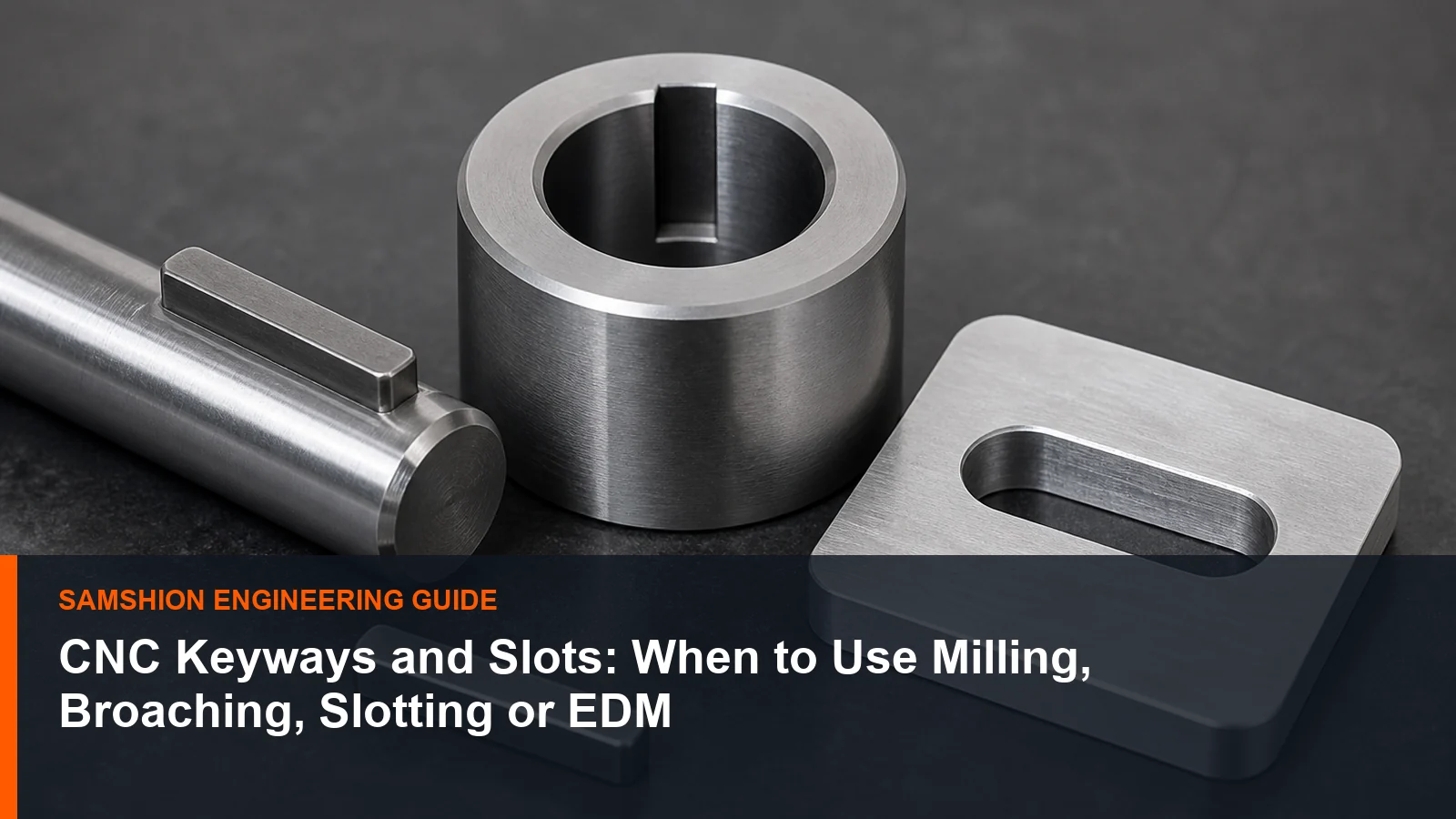
A keyway drawing often shows a width and depth but omits the information that controls process selection. The first distinction is whether the feature is an external keyseat, an internal through keyway or a blind internal slot.
Tool passage, end condition, material hardness, fit and production quantity then determine whether milling, broaching, slotting, shaping or EDM is practical.
Scope, Search Intent and Technical Boundary
This article compares manufacturing routes for keyways and slots. It is separate from the existing wire-EDM problem-solving and internal-radius articles. For broader geometry and specification guidance, use the CNC fixturing and setup guide alongside this feature-level discussion.
Use this guide to prepare an RFQ, review DFM comments and define acceptance evidence for CNC keyways and slots; it is not a universal capability promise.
Key Takeaways
- Classify the feature before selecting a process.
- State key and fit requirements, not only nominal slot width.
- Provide through access when a pull or push broach is expected.
- Use EDM when hardness or inaccessible geometry justifies it.
- Inspect width, depth and relationship to the rotational axis together.
Classify the Feature
External keyseats, through keyways and blind internal slots have different access and tooling requirements.
Milling External Keyseats and Slots
End mills and side cutters can generate accessible features but leave geometry determined by cutter path and radius. For the corresponding manufacturing decision and capability context, consult SAMSHION’s CNC milling services. General cutter-selection and engagement principles are available in the Sandvik Coromant milling knowledge resource, but the final method must still reflect slot access, end condition and part hardness.
Broaching Through Keyways
Broaching is efficient when a tool can pass completely through and quantity supports the tooling. For the corresponding manufacturing decision and capability context, consult SAMSHION’s CNC production machining.
Blind Internal Slots and Hardened Parts
Slotting, shaping, sinker EDM or wire EDM may be required when access or hardness prevents standard broaching. For the corresponding manufacturing decision and capability context, consult SAMSHION’s wire EDM problem-solving guide.
Fit and Inspection
Control width, depth, symmetry, burrs and end condition according to the mating key and torque path.
Engineering Variables to Confirm Before Quotation
External keyseat, internal through keyway or blind internal slot
For CNC keyways and slots, external keyseat, internal through keyway or blind internal slot requires an explicit engineering decision. Use this requirement to frame the first technical review. Ask which function depends on it, which datum or material state establishes it, and at what production stage it will be accepted. The decision can move a feature from a routine check to a controlled first-article characteristic. Keep the decision with the job record, because a verbal answer cannot control repeat work.
Slot width and fit class
For CNC keyways and slots, slot width and fit class requires an explicit engineering decision. Do not allow a default title-block tolerance to answer this question indirectly. Ask which function depends on it, which datum or material state establishes it, and at what production stage it will be accepted. The result governs how much process evidence is needed to support the quotation. Tie any relaxation to the actual function rather than to a generic shop capability statement.
Bottom geometry and end condition
For CNC keyways and slots, bottom geometry and end condition requires an explicit engineering decision. Reconcile the model, drawing and purchase specification at this point. Ask which function depends on it, which datum or material state establishes it, and at what production stage it will be accepted. It influences whether the feature is produced and accepted before or after secondary finishing. Where two documents disagree, obtain a controlled clarification before releasing material.
Tool access through the bore
For CNC keyways and slots, tool access through the bore requires an explicit engineering decision. Confirm the delivered-state requirement before estimating cycle time. Ask which function depends on it, which datum or material state establishes it, and at what production stage it will be accepted. It can alter support strategy, cutter access and the order of finishing operations. Where two documents disagree, obtain a controlled clarification before releasing material.
Part hardness and heat-treatment sequence
For CNC keyways and slots, part hardness and heat-treatment sequence requires an explicit engineering decision. Connect this variable to the mating or sealing function it protects. Ask which function depends on it, which datum or material state establishes it, and at what production stage it will be accepted. The result governs how much process evidence is needed to support the quotation. If the customer cannot confirm it, state the working assumption and its commercial effect in writing.
Production quantity and dedicated tooling
For CNC keyways and slots, production quantity and dedicated tooling requires an explicit engineering decision. Resolve this point while the process route is still flexible. Ask which function depends on it, which datum or material state establishes it, and at what production stage it will be accepted. A clear answer prevents manufacturing convenience from replacing functional intent. Where two documents disagree, obtain a controlled clarification before releasing material.
Failure Modes and Root-Cause Diagnosis
A blind internal keyway is quoted as if a standard pull broach can pass through
A characteristic failure for CNC keyways and slots occurs when a blind internal keyway is quoted as if a standard pull broach can pass through. The observation is evidence, not yet a root cause. Evaluate material behavior, support, cutter condition, programmed sequence and the measurement alignment as separate hypotheses. Use a controlled trial that changes one suspected mechanism while holding the remaining variables constant. Update the setup sheet and inspection plan so the fix survives the next batch.
Slot width is controlled but symmetry to the shaft axis is not
A characteristic failure for CNC keyways and slots occurs when slot width is controlled but symmetry to the shaft axis is not. The observation is evidence, not yet a root cause. Evaluate material behavior, support, cutter condition, programmed sequence and the measurement alignment as separate hypotheses. Separate geometry created by the toolpath from movement created by heat or fixture load. Do not hide the symptom with manual blending unless the drawing explicitly permits that edge condition.
Milling leaves end radii that interfere with a square-ended key
A characteristic failure for CNC keyways and slots occurs when milling leaves end radii that interfere with a square-ended key. The observation is evidence, not yet a root cause. Evaluate material behavior, support, cutter condition, programmed sequence and the measurement alignment as separate hypotheses. Check whether the indication follows the cutter, the setup, the material lot or the inspection alignment. Correct the mechanism and then revalidate the complete functional relationship.
Heat treatment changes a finished keyway
A characteristic failure for CNC keyways and slots occurs when heat treatment changes a finished keyway. The observation is evidence, not yet a root cause. Evaluate material behavior, support, cutter condition, programmed sequence and the measurement alignment as separate hypotheses. Map the symptom by feature location, tool life and operation sequence instead of averaging it into one result. Do not hide the symptom with manual blending unless the drawing explicitly permits that edge condition.
Process Controls for a Repeatable Result
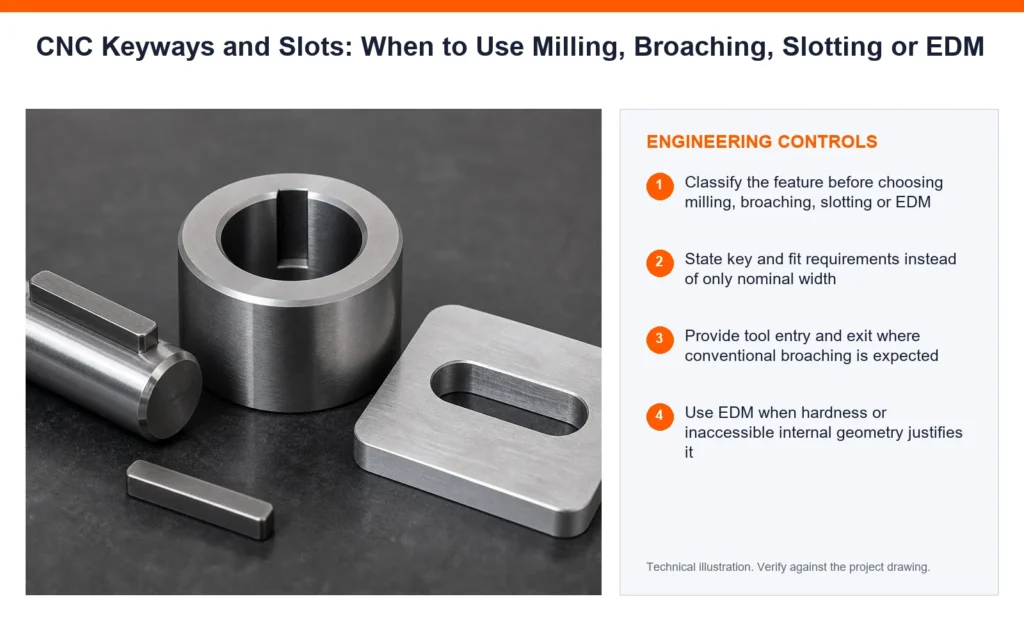
Classify the feature before choosing milling, broaching, slotting or EDM
A process plan for CNC keyways and slots can control this risk by choosing to classify the feature before choosing milling, broaching, slotting or EDM. The action is useful only when it targets a named source of variation. Before release, consider access, local stiffness, heat flow and the acceptance condition of neighboring features. Define the owner, frequency and record produced by the control. The inspector must evaluate the same condition the operator is controlling.
State key and fit requirements instead of only nominal width
A process plan for CNC keyways and slots can control this risk by choosing to state key and fit requirements instead of only nominal width. The action is useful only when it targets a named source of variation. Before release, consider access, local stiffness, heat flow and the acceptance condition of neighboring features. Use a short prototype trial first; formalize fixture, sampling and tool-life rules for repeat orders. A stable process is demonstrated by evidence across parts, not by one favorable measurement. The applicable production route and process controls are outlined in SAMSHION’s CNC turning services.
Provide tool entry and exit where conventional broaching is expected
A process plan for CNC keyways and slots can control this risk by choosing to provide tool entry and exit where conventional broaching is expected. The action is useful only when it targets a named source of variation. Before release, consider access, local stiffness, heat flow and the acceptance condition of neighboring features. Pair the control with a measurable limit rather than a general workmanship instruction. If it changes a controlled requirement, customer approval comes before production release.
Use EDM when hardness or inaccessible internal geometry justifies it
A process plan for CNC keyways and slots can control this risk by choosing to use EDM when hardness or inaccessible internal geometry justifies it. The action is useful only when it targets a named source of variation. Before release, consider access, local stiffness, heat flow and the acceptance condition of neighboring features. Prove the control on the first article and retain the before-and-after evidence. Repeat production should not depend on an operator remembering an undocumented exception.
Sequence heat treatment before the final sizing operation when appropriate
A process plan for CNC keyways and slots can control this risk by choosing to sequence heat treatment before the final sizing operation when appropriate. The action is useful only when it targets a named source of variation. Before release, consider access, local stiffness, heat flow and the acceptance condition of neighboring features. Review adjacent walls, threads, sealing lands and datums for unintended consequences. A stable process is demonstrated by evidence across parts, not by one favorable measurement.
Inspect width, depth and axis relationship together
A process plan for CNC keyways and slots can control this risk by choosing to inspect width, depth and axis relationship together. The action is useful only when it targets a named source of variation. Before release, consider access, local stiffness, heat flow and the acceptance condition of neighboring features. Define the owner, frequency and record produced by the control. Remove the control if trials show that it adds handling without reducing the targeted variation.
Inspection Strategy and Acceptance Evidence
Slot or keyway width with suitable gauges
Inspection of CNC keyways and slots should explicitly address slot or keyway width with suitable gauges. First define the characteristic, datum reference and part condition represented by the result. Build the datum alignment exactly as defined on the controlled drawing. For variable geometry, show the measurement locations instead of reporting one unexplained value.
Depth from the functional bore or shaft surface
Inspection of CNC keyways and slots should explicitly address depth from the functional bore or shaft surface. First define the characteristic, datum reference and part condition represented by the result. Sample the locations and depths where process behavior can genuinely change. A decimal-rich output is not credible if the instrument cannot resolve the tolerance.
Symmetry or position relative to the rotational axis
Inspection of CNC keyways and slots should explicitly address symmetry or position relative to the rotational axis. First define the characteristic, datum reference and part condition represented by the result. Sample the locations and depths where process behavior can genuinely change. For variable geometry, show the measurement locations instead of reporting one unexplained value.
End-radius and relief condition
Inspection of CNC keyways and slots should explicitly address end-radius and relief condition. First define the characteristic, datum reference and part condition represented by the result. Sample the locations and depths where process behavior can genuinely change. For variable geometry, show the measurement locations instead of reporting one unexplained value. The available verification and reporting workflow is summarized in SAMSHION’s quality assurance.
Burrs at the bore intersection
Inspection of CNC keyways and slots should explicitly address burrs at the bore intersection. First define the characteristic, datum reference and part condition represented by the result. Build the datum alignment exactly as defined on the controlled drawing. When results disagree, compare alignment, force, temperature and feature definition before averaging values.
Cost, Lead Time and Quotation Transparency
Blind versus through access
In a quotation for CNC keyways and slots, blind versus through access can influence both lead time and total manufacturing cost. The quantity and cost of a scrapped blank change how much prevention is economically justified. Show the driver separately so the customer can judge whether the protected function warrants it.
Special broach or electrode
In a quotation for CNC keyways and slots, special broach or electrode can influence both lead time and total manufacturing cost. The cost can move from machining into inspection programming, gauging or documentation. Do not reduce price by silently omitting the requested acceptance evidence.
Material hardness
In a quotation for CNC keyways and slots, material hardness can influence both lead time and total manufacturing cost. It may increase setup time, prove-out time or the risk allowance on expensive stock. Show the driver separately so the customer can judge whether the protected function warrants it.
Quantity sufficient to justify dedicated tooling
In a quotation for CNC keyways and slots, quantity sufficient to justify dedicated tooling can influence both lead time and total manufacturing cost. A prototype route may be economical once but unsuitable for a repeating order. Identify whether the commercial risk comes from capability, ambiguity or verification effort.
A Practical Engineering Review Sequence
Start with the function protected by external keyseat, internal through keyway or blind internal slot. Mark the related datums, interfaces and delivered-state requirements on the controlled drawing. The manufacturing review can then choose stock, setups and cutting access around that function instead of treating every dimension as equally critical.
Walk through the likely failure mechanism represented by this project: a blind internal keyway is quoted as if a standard pull broach can pass through. Decide which evidence can reveal the problem earliest and which operation can still correct it. This ordering avoids discovering a predictable condition only after finishing or final inspection.
Use the first article to validate the proposed control, including the instruction to classify the feature before choosing milling, broaching, slotting or EDM. The approval part must represent the intended material, fixture, program, secondary operations and measurement alignment. Feed the result back into the process record before releasing the balance of the order. Use the 5-axis CNC machining to connect this decision with the wider manufacturing workflow.
RFQ and DFM Checklist
- Native 3D CAD model plus a controlled 2D drawing for tolerances and notes
- Exact material grade, condition, stock preference and certification requirement
- Functional datums, mating components and genuinely critical characteristics
- Quantity, prototype or production intent, and expected repeat-order status
- Surface finish, coating, heat treatment, cleaning and marking requirements
- Inspection report, certificate, gauge or sampling requirements
- Any approved alternative geometry or process constraints
Additional Engineering Review Notes
An additional risk review should connect the drawing statement to the evidence available at final acceptance. For CNC keyways and slots, examine external keyseat, internal through keyway or blind internal slot and ask how it could contribute to a condition in which slot width is controlled but symmetry to the shaft axis is not. One candidate action is to provide tool entry and exit where conventional broaching is expected; however, its value must be demonstrated through end-radius and relief condition. Preserve enough traceability to connect the observation to material lot, setup and program revision. Also consider the commercial effect of blind versus through access, because a technically sound route must be quoted with transparent assumptions. A control that cannot be checked objectively should be rewritten before it enters the setup sheet.
The project team should test whether its acceptance rule still makes sense after all secondary operations. For CNC keyways and slots, examine slot width and fit class and ask how it could contribute to a condition in which milling leaves end radii that interfere with a square-ended key. One candidate action is to use EDM when hardness or inaccessible internal geometry justifies it; however, its value must be demonstrated through burrs at the bore intersection. Check whether unclamping, cleaning or finishing changes the apparent mechanism. Also consider the commercial effect of special broach or electrode, because a technically sound route must be quoted with transparent assumptions. A control that cannot be checked objectively should be rewritten before it enters the setup sheet.
For this feature family, compare the intended function with the easiest available measurement and resolve any mismatch. For CNC keyways and slots, examine bottom geometry and end condition and ask how it could contribute to a condition in which heat treatment changes a finished keyway. One candidate action is to sequence heat treatment before the final sizing operation when appropriate; however, its value must be demonstrated through slot or keyway width with suitable gauges. Compare the result with a second part, setup or tool-life interval before declaring a systemic cause. Also consider the commercial effect of material hardness, because a technically sound route must be quoted with transparent assumptions. Keep the approved method connected to the fixture, program and inspection revision.
An additional risk review should connect the drawing statement to the evidence available at final acceptance. For CNC keyways and slots, examine tool access through the bore and ask how it could contribute to a condition in which a blind internal keyway is quoted as if a standard pull broach can pass through. One candidate action is to inspect width, depth and axis relationship together; however, its value must be demonstrated through depth from the functional bore or shaft surface. Preserve enough traceability to connect the observation to material lot, setup and program revision. Also consider the commercial effect of quantity sufficient to justify dedicated tooling, because a technically sound route must be quoted with transparent assumptions. Use the first article to demonstrate the relationship between the action and the protected function.
For this feature family, compare the intended function with the easiest available measurement and resolve any mismatch. For CNC keyways and slots, examine part hardness and heat-treatment sequence and ask how it could contribute to a condition in which slot width is controlled but symmetry to the shaft axis is not. One candidate action is to classify the feature before choosing milling, broaching, slotting or EDM; however, its value must be demonstrated through symmetry or position relative to the rotational axis. Use the failed condition to define a controlled trial, not as permission for an undocumented rework step. Also consider the commercial effect of blind versus through access, because a technically sound route must be quoted with transparent assumptions. Escalate a trend at the warning limit instead of waiting for a rejected final result.
Frequently Asked Questions
Can a standard broach cut a blind keyway?
A conventional pull or push broach normally needs through travel. Blind features require another approach. Treat this as planning guidance and document any project assumption in the quotation.
Why does a milled slot have rounded ends?
The rotating cutter creates an end radius unless relief or another process is specified. Treat this as planning guidance and document any project assumption in the quotation.
Is EDM always the most accurate option?
No. EDM is valuable for hardness and access, but process choice also depends on finish, recast layer, cost and quantity. Treat this as planning guidance and document any project assumption in the quotation.
Should keyway width alone be inspected?
No. Depth, position, symmetry, burrs and mating-key function can also be critical. Supplier and customer should agree the feature definition before production begins.
Get an Engineering Review
Upload the CAD model and controlled drawing for an engineering review before production. When the model and drawing are ready, use upload the shaft and hub drawings and include the material, quantity, finish and inspection requirements.
For a review of CNC keyways and slots, send the native CAD model, controlled drawing, material specification, quantity, finishing route and required acceptance records. SAMSHION’s engineering team can return project-specific DFM questions and documented quotation assumptions before production begins.