PTFE is useful when chemical resistance, low friction, electrical insulation or broad service-temperature behavior matters. It is also one of the easiest engineering plastics to misjudge during precision machining because it is soft, compliant and strongly affected by time, temperature and measurement force.
A dimension that looks correct while the part is clamped can move after release. A bore checked with too much contact force can appear smaller than it really is. A robust process therefore connects material grade, stock history, support, cutting strategy, conditioning and final inspection.
SAMSHION machines PTFE parts such as seals, rings, bushings and insulators as part of our CNC machining services. This guide explains what changes when the material is PTFE instead of metal.
Key Takeaways
- Confirm virgin or filled PTFE before quoting.
- Spread clamp pressure over broad, supportive contact.
- Use sharp positive tools and prevent rubbing heat.
- Allow the component to reach a defined free-state condition before final measurement.
- Apply tight tolerances only where function requires them.
Why PTFE Needs a Different Machining Plan
PTFE has lower stiffness and greater thermal movement than common metals. It can also creep under sustained load, so fixture pressure and inspection force are part of the dimensional result. See our custom CNC machining services. The Ensinger machining guidelines for semi-finished plastics also emphasize that polymer machining decisions must account for material behavior, heat and residual stress rather than copying a metal-cutting process unchanged.
Material Grade and Stock History
Virgin, glass-filled, carbon-filled and modified PTFE grades do not respond identically. The purchase specification should identify grade, color, stock form and certification.
Clamping Rings, Sleeves and Thin Flanges
Broad soft jaws, sleeves and shaped nests reduce concentrated pressure. The component should be checked after complete release from the fixture. See our CNC turning services.
Cutting, Burr Control and Surface Integrity
Sharp positive tools reduce rubbing. Cross holes, sealing grooves and thin edges need planned deburring access. See our polymer CNC machining challenges.
Conditioning and Low-Force Inspection
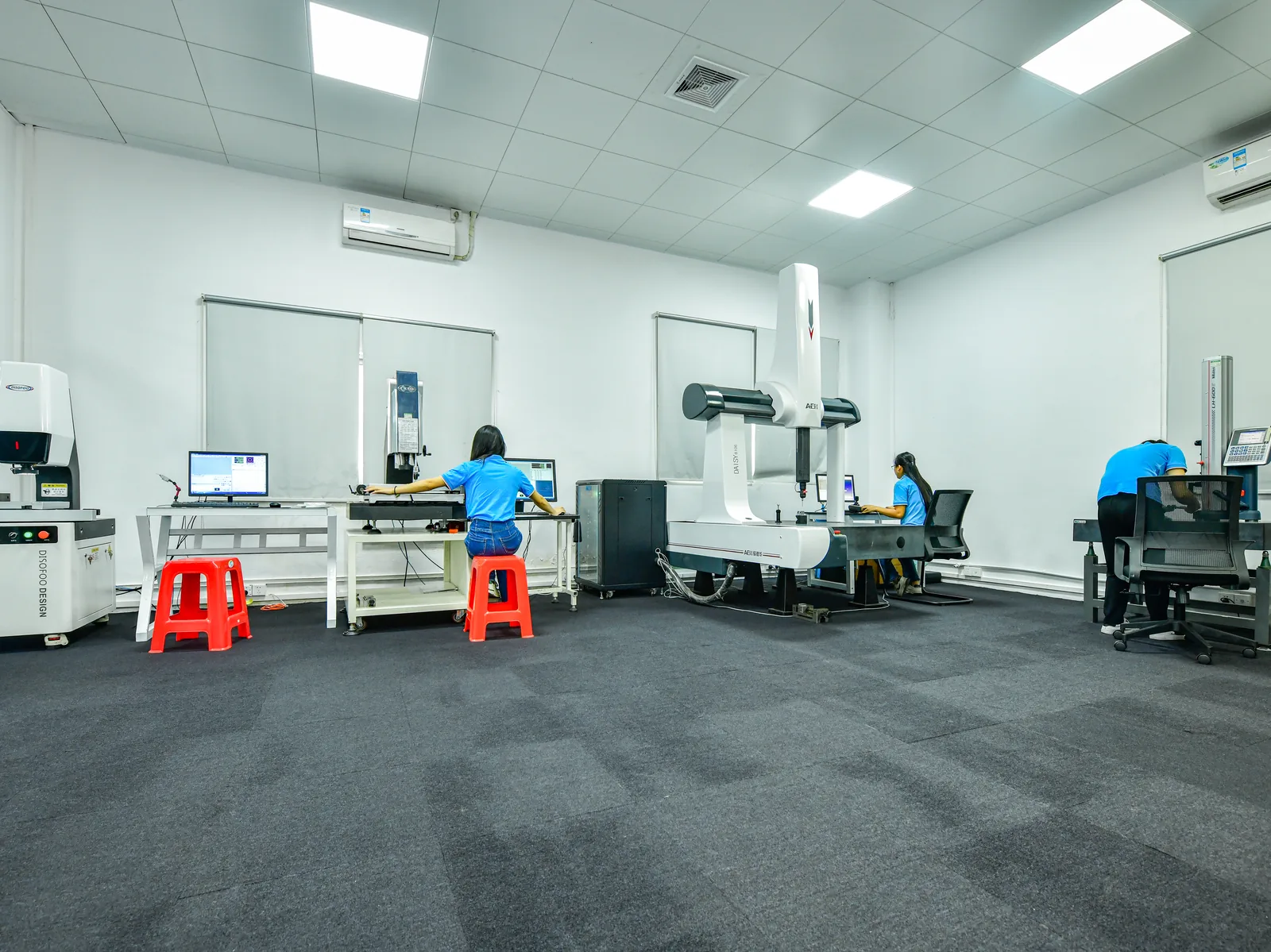
Critical dimensions should be checked after the agreed conditioning period and at the stated temperature. Measurement force must not visibly deform the feature.
PTFE Properties That Matter for Machining
PTFE behaves very differently from metals and from stiffer engineering plastics. The properties below explain most of the machining and inspection problems seen on PTFE parts:
- Very low friction: one of the lowest coefficients of friction of any solid material, which is why PTFE is chosen for seals, slide pads and bushings. The same slipperiness makes the part harder to hold in a fixture.
- High thermal expansion: PTFE expands roughly five times more than aluminum per degree of temperature change. A few degrees of difference between the machine shop and the inspection room is enough to move a large diameter by several hundredths of a millimeter.
- Room-temperature transition: PTFE has a crystalline transition at about 19 °C, where its volume changes noticeably. Parts measured just below and just above this temperature can give different readings.
- Creep (cold flow): under constant load PTFE slowly deforms. Clamping force, gauge pressure and the load in the final assembly all matter.
- Softness: the material is easy to cut but easy to mark, dent and deform with a sharp edge, a heavy clamp or a measuring anvil.
- Wide service temperature and chemical resistance: PTFE is used from cryogenic temperatures up to about 260 °C and resists almost all industrial chemicals.
Virgin vs Filled PTFE Grades
The grade should be fixed on the drawing before quoting, because fillers change stiffness, wear, color, tool life and application approvals.
- Virgin PTFE: white, purest form, best electrical insulation and chemical resistance, but the softest and the most prone to creep.
- Glass-filled PTFE (typically 15 to 25 percent): better creep resistance and dimensional stability; more abrasive to cutting tools.
- Carbon- or graphite-filled PTFE: improved wear resistance and thermal conductivity, common for piston rings and dynamic seals.
- Bronze-filled PTFE: high compressive strength and wear resistance for bearings and guide strips; not suitable where electrical insulation is required.
- Modified PTFE: a denser second-generation grade with lower creep and smoother surfaces, often used for valve seats and sealing parts.
Tooling and Cutting Parameters
PTFE cuts easily, so the challenge is not cutting force but heat, deflection and surface quality. General practice is:
- Use very sharp tools with a high positive rake angle and polished flutes. Dull tools rub, raise heat and push the material away instead of cutting it.
- Run relatively high spindle speeds with moderate feeds, and avoid letting the tool dwell in one spot.
- Use air blast or a non-aggressive coolant to carry heat away, because local heating causes immediate expansion and an undersize feature after cooling.
- Drill with sharp drills and peck cycles. Drilled holes in PTFE often close up slightly after the drill exits, so tight holes are normally finished by boring or reaming.
- Leave a finishing allowance and take a light final pass after roughing, so stress released during roughing does not end up in the finished dimension.
- Remove the thin, stringy burrs PTFE produces with a sharp blade rather than abrasive methods that can embed particles in the surface.
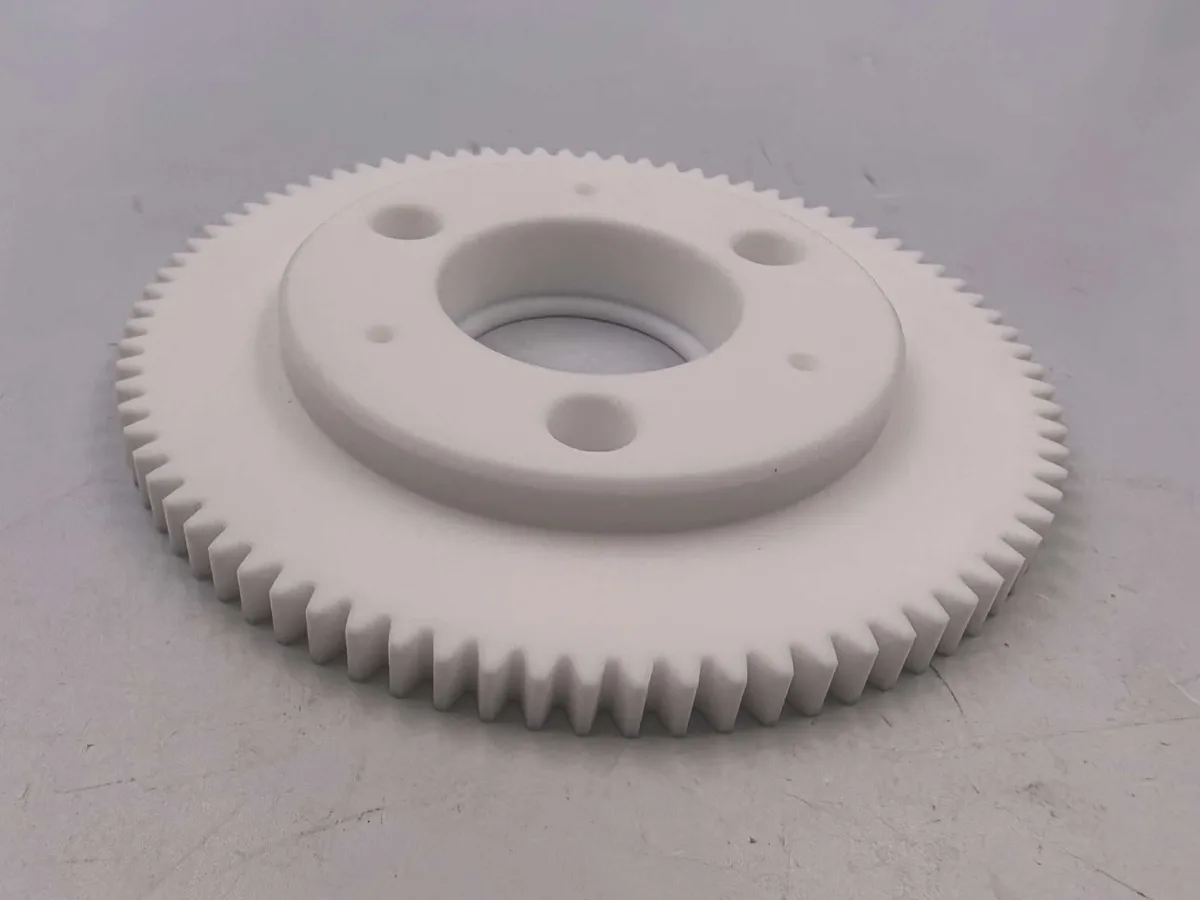
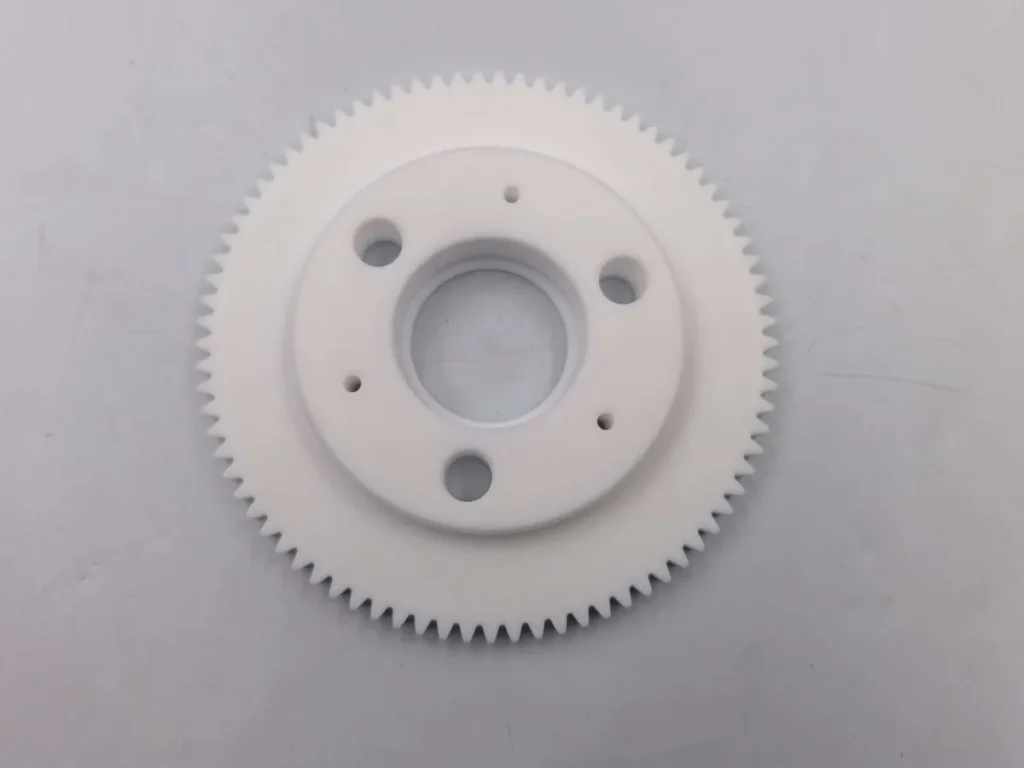
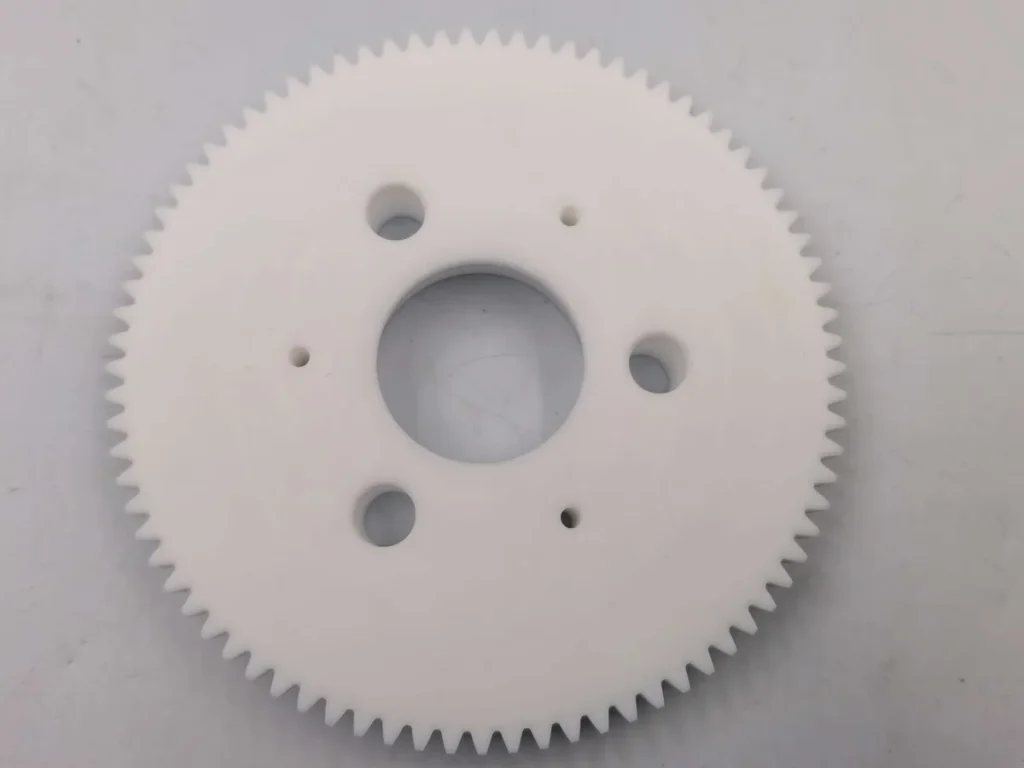
The white PTFE gear below was CNC machined from PTFE, with a raised hub, counterbored mounting holes and a center bore. Thin teeth and flat faces like these need sharp tools, light finishing passes and gentle clamping to stay accurate.
A Worked Example: PTFE Sealing Ring
Consider a virgin PTFE sealing ring with an outer diameter of 80 mm, a wall thickness of 3 mm and a sealing face that must be flat for a gasket application. A plan that works for an aluminum ring of the same size would fail here for several reasons:
- Three-jaw clamping on the thin wall would make the ring oval; when released, it springs back and the bore is no longer round. A full-length soft sleeve or expanding mandrel spreads the load.
- Roughing and finishing in one operation would leave internal stress in the part. Roughing, a rest period, and then a light finishing pass give a more stable ring.
- If the ring is measured in a warm shop straight after machining and then again in an air-conditioned inspection room the next day, the two readings can disagree. The drawing should state the measuring temperature and conditioning time.
- A micrometer tightened with normal force can compress the wall. Non-contact measurement or a low-force gauge gives a more honest reading.
None of these points require special machines; they require the process, fixture and inspection plan to be designed for PTFE from the start.
What Drives the Cost of PTFE Parts
- Material grade and stock form: filled and modified grades cost more than virgin PTFE, and large-diameter rod or thick plate is expensive per kilogram.
- Tolerance and temperature control: tight tolerances on large diameters need conditioning time and temperature-controlled measurement.
- Custom fixtures: thin rings, sleeves and flanges often need dedicated soft jaws, mandrels or nests.
- Multiple operations: rough, rest and finish cycles add handling time.
- Inspection method: non-contact or low-force measurement takes longer than standard gauging.
- Quantity: fixture and programming costs are spread over the batch, so unit cost drops sharply from one-off prototypes to repeat orders.
Common PTFE Design Mistakes
- Copying metal tolerances onto a PTFE drawing without considering thermal expansion and creep.
- Not stating the PTFE grade, so the quote and the application approval are based on different materials.
- Specifying knife-thin sealing lips or edges that deform during machining and handling.
- Leaving the measuring temperature and conditioning time undefined for critical dimensions.
- Designing press-fits with metal-style interference; PTFE creeps and the fit relaxes over time.
- Expecting PTFE to replace a structural material. When stiffness and dimensional stability matter more than chemical resistance, a material such as POM (Delrin) is often a better choice.
Frequently Asked Questions
Can PTFE hold tight tolerances?
Yes on suitable features, but geometry, grade, temperature, time and measurement force must be controlled.
Is filled PTFE always more stable?
Fillers can improve some properties but also change tool wear, surface behavior and application compatibility.
Should PTFE dimensions be measured immediately after machining?
Not when the drawing or process requires a stabilized condition. The inspection timing should be defined.
Can a standard steel-part gauge be used?
Only if its contact force and geometry do not distort the PTFE feature.
Why does the same PTFE part measure differently on different days?
PTFE has high thermal expansion and a volume transition near 19 °C, so small changes in room temperature change the reading. Measuring at an agreed temperature after an agreed conditioning time removes most of this variation.
Is PTFE suitable for food or medical applications?
Some PTFE grades carry food-contact or medical certifications, but not all do, and fillers can change approval status. The required certification should be stated on the drawing or purchase order so the correct certified stock is ordered.
When should I choose POM instead of PTFE?
Choose POM when the part needs stiffness, dimensional stability and tighter tolerances at normal temperatures. Choose PTFE when chemical resistance, very low friction, electrical insulation or high service temperature are the priority. See our POM machining guide and our CNC machining services.
Get an Engineering Review
Upload the CAD model and controlled drawing for an engineering review before production. When the model and drawing are ready, use upload your CAD files and include the material, quantity, finish and inspection requirements.
For a review of CNC machining PTFE parts, send the native CAD model, controlled drawing, material specification, quantity, finishing route and required acceptance records. SAMSHION’s engineering team can return project-specific DFM questions and documented quotation assumptions before production begins.