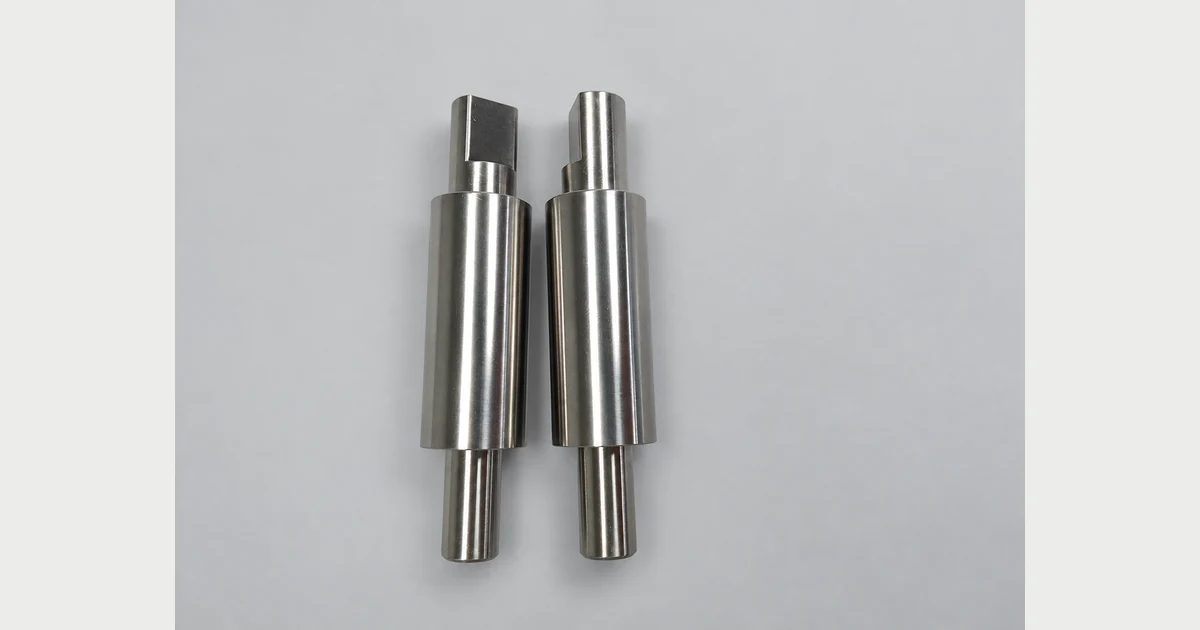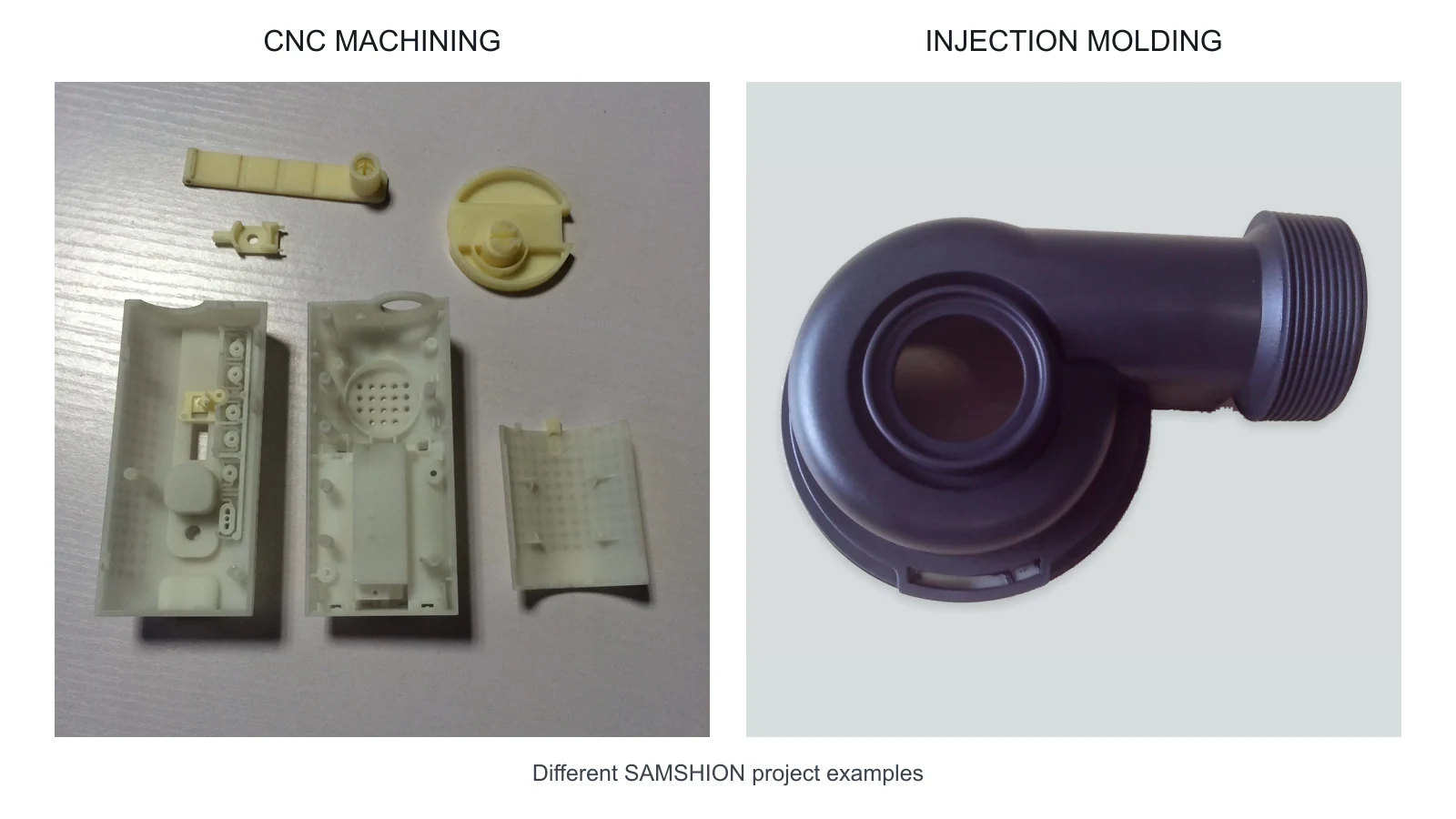
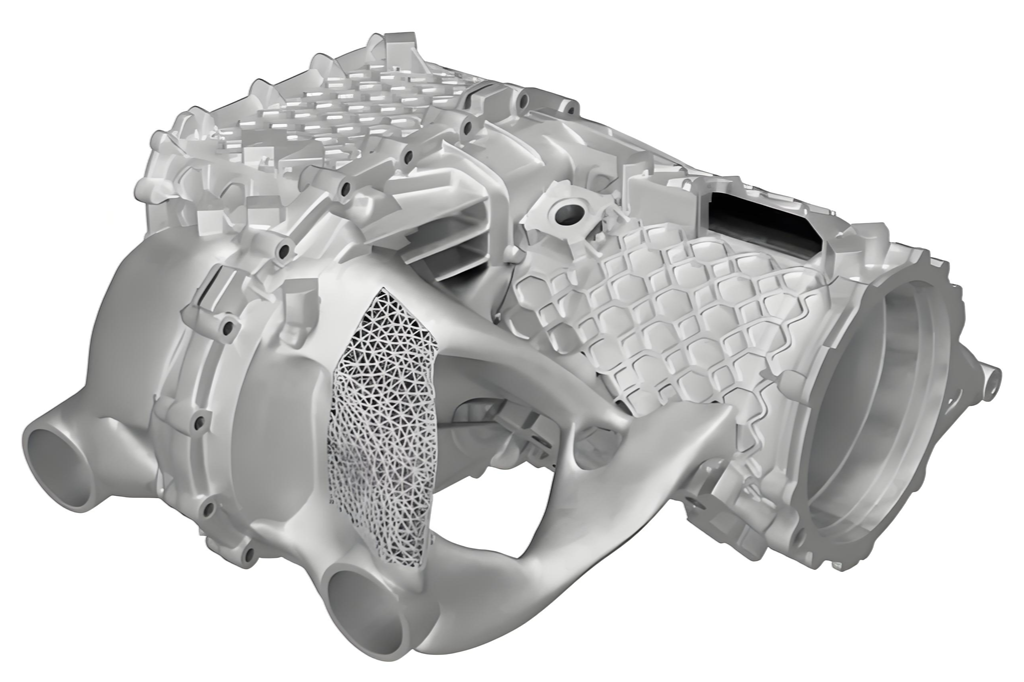
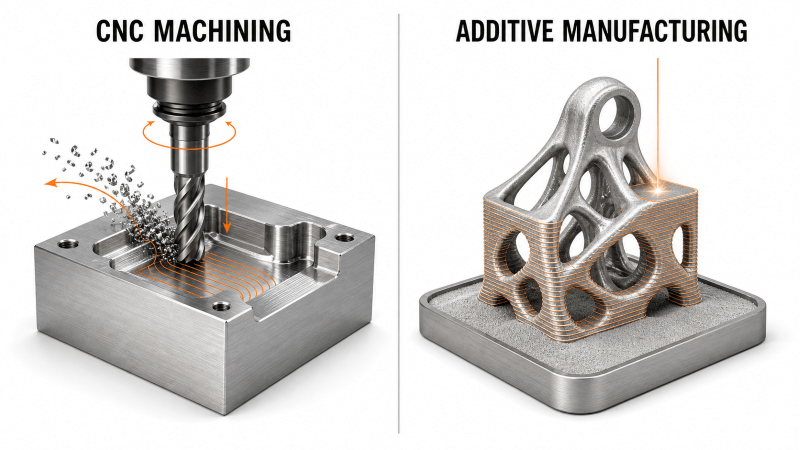
CNC machining and additive manufacturing can both produce prototypes and end-use parts, but they create components in fundamentally different ways. CNC machining removes material from solid stock, while additive manufacturing builds a part by adding material layer by layer.
Neither process is universally better. CNC machining is often preferred for production-grade materials, controlled dimensions, smooth surfaces and repeatable batches. Additive manufacturing is especially valuable for internal channels, lattice structures, part consolidation and low-volume designs that would be difficult to reach with cutting tools.
The correct choice depends on the part geometry, material, tolerance, surface finish, quantity, mechanical requirements, inspection plan and total delivered cost. In some projects, the most effective solution combines both processes.
Quick Answer: CNC Machining or Additive Manufacturing?
Choose CNC machining when the project requires:
-
Production-grade metal or plastic stock
-
Tight fits and controlled critical dimensions
-
Smooth machined surfaces
-
Threads, bores and precision interfaces
-
Predictable transition from prototype to repeat production
-
Straightforward geometry that cutting tools can access
Choose additive manufacturing when the project requires:
-
Enclosed internal channels
-
Lattice or topology-optimized structures
-
Part consolidation
-
Frequent design changes
-
Customized one-off components
-
Geometry that cannot be reached by conventional cutting tools
Choose a hybrid process when the part requires the geometric freedom of additive manufacturing together with machined sealing surfaces, bores, threads, datum features or other critical interfaces.
For project-specific support, compare Samshion’s custom CNC machining services and industrial 3D printing services.
What Is CNC Machining?
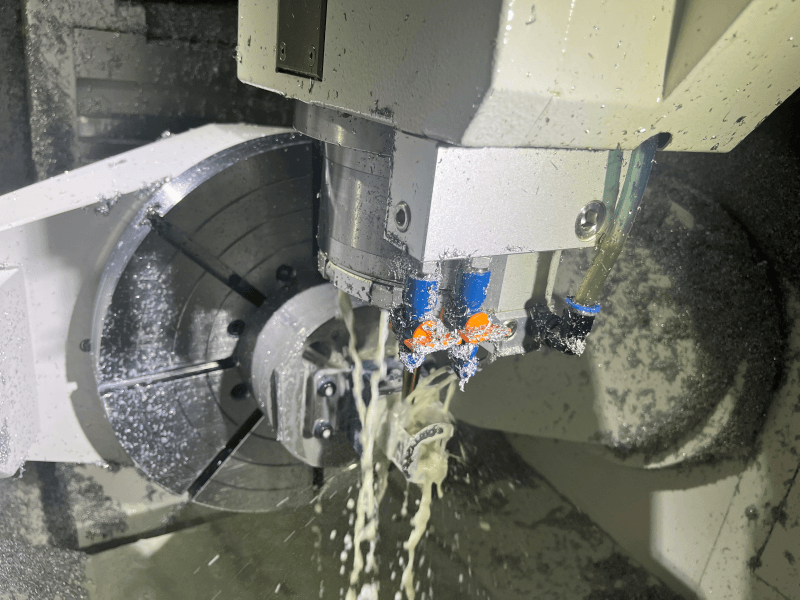
CNC machining is a subtractive manufacturing process in which computer-controlled machine tools remove material from a workpiece. The starting material may be a block, plate, bar, tube, casting, forging or near-net-shape blank.
A typical CNC workflow begins with a 3D CAD model and, when necessary, a 2D engineering drawing. CAM software converts the part geometry into toolpaths, and a post-processor generates machine-specific NC code.
The CNC controller uses this program to control:
-
Tool movement
-
Spindle speed
-
Feed rate
-
Cutting depth
-
Coolant operation
-
Tool changes
-
Rotary-axis positioning
Common CNC operations include milling, turning, drilling, boring, threading and electrical discharge machining. Three-, four- and five-axis machining centers provide different levels of tool access and geometric capability.
CNC machining remains dependent on skilled process planning. Engineers must select the tooling, workholding method, machining sequence and inspection strategy. Tool wear, cutting force, temperature and part deformation must also be controlled.
For a complete explanation of the process, read What Is CNC Machining?.
What Is Additive Manufacturing?
Additive manufacturing creates a physical three-dimensional object through the successive addition of material. This definition is established in ISO/ASTM 52900.
The term “3D printing” is often used interchangeably with additive manufacturing, but additive manufacturing includes several different process categories. The selected process strongly affects material behavior, dimensional capability, surface condition and post-processing requirements.
Material Extrusion
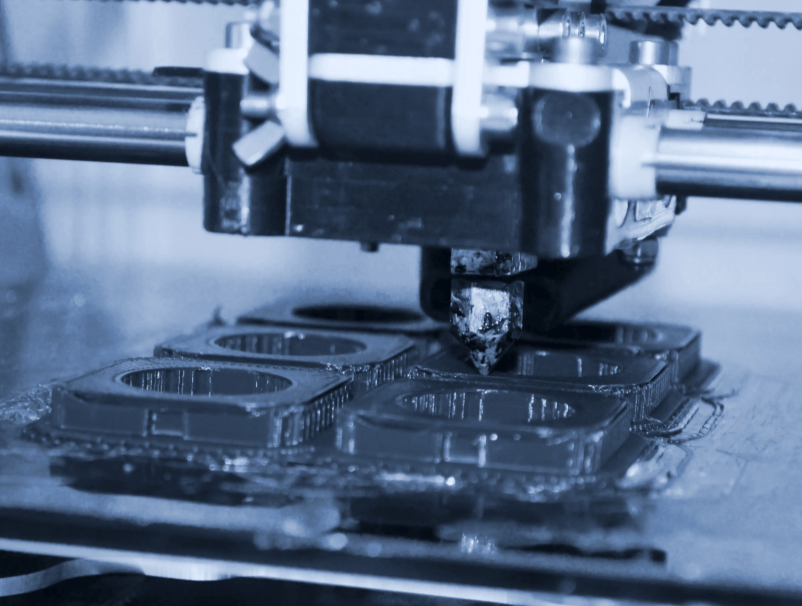
Material extrusion processes such as FDM deposit heated thermoplastic filament through a nozzle. FDM is commonly used for concept models, fixtures and functional polymer prototypes.
Vat Photopolymerization
SLA uses light to cure liquid photopolymer resin. It can produce detailed visual models and smooth cosmetic surfaces, but final properties depend on resin type, orientation and post-curing.
Polymer Powder Bed Fusion
SLS and MJF use polymer powder to produce complex functional parts. Unsintered powder supports much of the geometry during the build, reducing the need for separate support structures.
Metal Powder Bed Fusion
Metal processes such as SLM or laser powder bed fusion selectively melt thin layers of metal powder. They can produce complex metal components, but normally require support removal, stress relief, cleaning and machining of critical surfaces.
Different additive processes should not be treated as if they have identical accuracy, strength, surface finish or cost.
CNC Machining vs Additive Manufacturing: Key Differences
Material Formation
CNC machining normally starts with solid stock that has already undergone processes such as rolling, extrusion, forging or heat treatment. Material is removed until the required part remains.
Additive manufacturing creates the component during the build. The process parameters, layer orientation, thermal history, support strategy and post-treatment can therefore influence the final microstructure and mechanical performance.
A machined part is not automatically stronger than every additively manufactured part. A properly qualified metal AM process with suitable heat treatment and inspection can produce high-performance components. However, the properties cannot be assumed to match wrought material without process-specific data.
Geometric Freedom and Tool Access
CNC machining requires physical access for the cutting tool, holder and machine spindle. Enclosed internal cavities cannot normally be machined after the exterior has been completed unless the part is separated, assembled or processed using another method.
Additive manufacturing can create:
-
Enclosed or semi-enclosed channels
-
Lattice structures
-
Topology-optimized geometry
-
Organic shapes
-
Integrated ducts
-
Consolidated assemblies
-
Variable wall structures
However, AM does not provide unlimited design freedom. Metal powder must be removable from internal passages, support structures must be accessible, and overhangs must be designed for the selected process.
Complex external geometry that appears ideal for additive manufacturing may also be produced efficiently through 5-axis CNC machining if the cutting tool can reach every surface.
Dimensional Accuracy and Repeatability
CNC machining generally provides better control of critical dimensions, bores, threads, sealing faces and mating features directly from the machine.
Additive manufacturing accuracy depends on the printing technology, part orientation, build size, thermal distortion, layer thickness, support strategy and post-processing. Large or thin metal AM components may move during printing, stress relief or support removal.
For either process, tolerance must be reviewed feature by feature. A single tolerance value should not be applied to every material, geometry or part size.
When an AM component contains precision interfaces, additional CNC machining is often added after printing.
Surface Finish
CNC-machined surfaces normally contain directional cutting marks. Their roughness is influenced by the cutting tool, toolpath, feed rate, spindle speed, material and finishing passes.
Additively manufactured surfaces can show layer lines, partially fused particles, support marks or stair-stepping. Surface condition varies significantly between FDM, SLA, SLS, MJF and metal powder bed fusion.
AM parts may require:
-
Support removal
-
Bead blasting
-
Tumbling
-
Polishing
-
CNC machining
-
Grinding
-
Shot peening
-
Coating
-
Heat treatment
Surface finishing should be considered during design and quotation, not after the part has already been manufactured. Review common CNC machining surface finish options when defining appearance and functional surface requirements.
Material Availability
CNC machining can use a broad selection of commercially available metals and plastics. Designers can often select a specific alloy, temper, grade or polymer based on established material specifications.
Additive manufacturing material availability is more process dependent. A material must be available in a suitable powder, filament, resin or wire form and must be qualified for the selected equipment and parameters.
When an exact production alloy or certified stock condition is required, CNC machining may offer a more direct path. When geometry is the dominant requirement, a qualified additive material may provide greater design freedom.
Compare both process families in Samshion’s manufacturing materials guide.
Material Utilization
CNC machining can generate significant chips when a finished part occupies only a small portion of the original stock. Scrap can often be recycled, but it still represents purchased material and machining time.
Additive manufacturing places material closer to the final geometry. This can improve material utilization for expensive alloys and highly organic shapes.
AM is not waste-free. Support structures, failed builds, test coupons, trapped powder, powder refresh requirements and machining allowance must also be included in the material calculation.
Part Size and Build Envelope
CNC part size is limited by machine travel, workholding, tool reach and the ability to reposition the component.
AM part size is limited by the machine’s build volume. Large metal builds may also face thermal distortion, long build times and higher failure risk.
A part that exceeds the available build volume may be divided and joined, but this can reduce the advantage of part consolidation. The same part might instead be machined from multiple components or manufactured through a hybrid route.
CNC and Additive Manufacturing Comparison Table
| Factor | CNC Machining | Additive Manufacturing |
|---|---|---|
| Manufacturing Principle | Removes material from stock | Adds material layer by layer |
| Best Geometry | Tool-accessible features | Internal channels and lattice structures |
| Material Selection | Broad range of standard stock | Limited to process-qualified feedstock |
| Critical Dimensions | Generally easier to control directly | Often requires finish machining |
| Surface Condition | Machining marks | Layer lines, powder texture or support marks |
| Setup Requirements | Programming, tools and workholding | Build preparation, orientation and supports |
| Post-Processing | Deburring and optional finishing | Cleaning, support removal and often heat treatment |
| Material Utilization | Lower for high material-removal ratios | Potentially higher for organic geometry |
| Customization | CAD/CAM program changes | Digital file and build changes |
| Production Scaling | Efficient for repeat batches | Useful for customization and complex low volumes |
| Main Constraint | Cutting-tool access | Build envelope and process qualification |
CNC Machining vs Additive Manufacturing Cost
The cost comparison should be based on the complete delivered component, not only the machine cycle or print time.
CNC Machining Cost Factors
CNC machining cost includes:
-
Raw stock
-
CAM programming
-
Cutting tools
-
Workholding
-
Machine setup
-
Cutting time
-
Tool wear
-
Deburring
-
Inspection
-
Surface finishing
Simple components can be machined quickly. Complex parts with deep cavities, thin walls, multiple setups or extensive material removal require more time.
Additive Manufacturing Cost Factors
Additive manufacturing cost includes:
-
Build preparation
-
Material feedstock
-
Machine build time
-
Support structures
-
Test coupons
-
Cooling and depowdering
-
Support removal
-
Stress relief or heat treatment
-
Surface finishing
-
CNC finish machining
-
Inspection and qualification
AM has no conventional cutting fixture for every surface, but it should not be described as having “no setup cost.” Build orientation, support design, machine preparation and post-processing planning are important setup activities.
One-Off Prototypes
Polymer additive manufacturing can be economical for visual models and early design verification, especially when tight tolerances and production material properties are not required.
For metal prototypes, the result is less predictable. A simple aluminum bracket may be faster and less expensive to machine from stock, while an internally channeled component may be more practical to print.
Low-Volume and Repeat Production
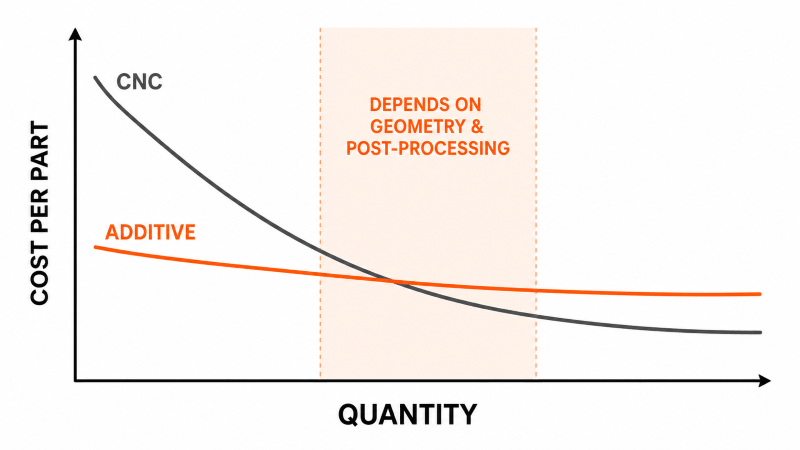
As quantity increases, CNC programming and setup costs are distributed across more parts. Fixtures and optimized toolpaths can improve cycle time and consistency.
AM can place multiple parts in one build, but each additional layer still requires processing across the build area. The most economical method depends on part size, build packing, print duration, support requirements and post-processing.
Total Cost of Ownership for the Part
The lowest initial part price may not represent the lowest project cost. Engineers should also consider:
-
Design changes required for production
-
Qualification and testing
-
Assembly reduction
-
Material waste
-
Inspection effort
-
Surface finishing
-
Failure risk
-
Delivery schedule
-
Future production quantities
CNC Machining vs Additive Manufacturing Lead Time
Additive manufacturing is often associated with rapid prototyping, but it is not automatically faster for every component.
An AM build may begin without conventional workholding, but the complete lead time can include support design, printing, cooling, cleaning, stress relief, support removal, machining and inspection.
CNC machining requires programming and setup, but a simple component can sometimes be produced rapidly from available stock.
Lead time is affected by:
-
Material availability
-
Machine capacity
-
Part dimensions
-
Build or machining time
-
Number of setups
-
Post-processing
-
Inspection
-
Quantity
-
Shipping
For early product development, Samshion’s rapid prototyping services combine CNC machining and multiple 3D printing processes so that the technology can be selected according to the actual design.
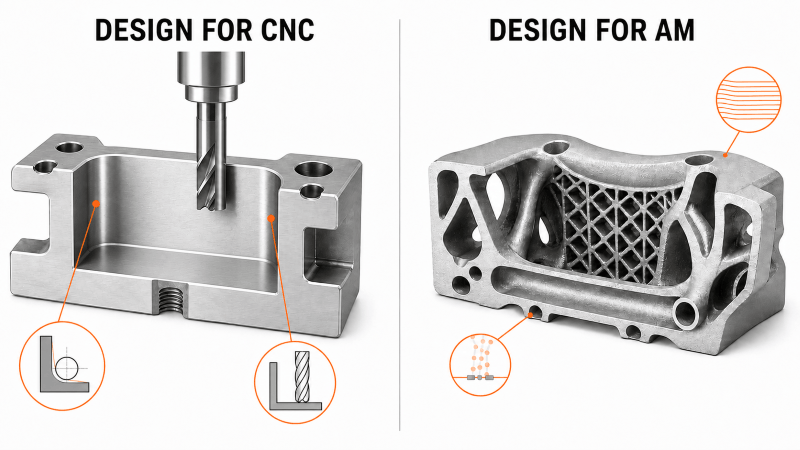
Design Guidelines for CNC and Additive Manufacturing
Design Guidelines for CNC Machining
For CNC-machined components:
-
Provide cutting-tool access to every machined feature.
-
Use practical internal corner radii.
-
Avoid unnecessarily deep and narrow cavities.
-
Maintain adequate wall thickness.
-
Use standard holes, threads and tool sizes.
-
Apply tight tolerances only to functional features.
-
Minimize the number of machining orientations.
-
Provide a 2D drawing for GD&T, threads and surface specifications.
Learn how internal corner radii affect CNC milling.
Design Guidelines for Additive Manufacturing
For additively manufactured components:
-
Select the build orientation according to strength, accuracy and surface requirements.
-
Identify overhangs that need support.
-
Make supports accessible for removal.
-
Provide powder-removal or drainage openings for internal cavities.
-
Avoid trapped volumes that cannot be inspected or cleaned.
-
Allow machining stock on critical surfaces.
-
Consider thermal distortion and residual stress.
-
Define which surfaces require post-processing.
-
Confirm that lattice structures can be cleaned and inspected.
-
Avoid copying a CNC design directly without considering DfAM.
The design should match the selected AM technology. A geometry optimized for SLS may not be suitable for FDM, SLA or metal powder bed fusion without modification.
When Should You Choose CNC Machining?
CNC machining is generally the stronger candidate when:
-
The geometry is accessible to cutting tools.
-
The project requires a specific stock material or temper.
-
Critical bores, threads and mating surfaces dominate the design.
-
Surface quality is important.
-
The prototype must closely represent the future production component.
-
Repeat batches are expected.
-
Dimensional inspection is the primary qualification method.
-
The part contains simple or moderately complex geometry.
-
A large selection of engineering metals or plastics is required.
CNC machining is especially useful for functional prototypes that must reproduce the material and interface conditions of the final design.
When Should You Choose Additive Manufacturing?
Additive manufacturing is generally the stronger candidate when:
-
Internal channels cannot be machined conventionally.
-
A lattice structure provides functional value.
-
Several components can be consolidated into one part.
-
The geometry has been topology optimized.
-
Every part requires customization.
-
The design is changing frequently.
-
A polymer concept model is needed quickly.
-
Conventional tooling access is impossible.
-
Material utilization is important for an expensive alloy.
-
The design can tolerate the required post-processing.
The strongest reason to choose AM is usually geometric or functional advantage, not simply the assumption that printing is cheaper.
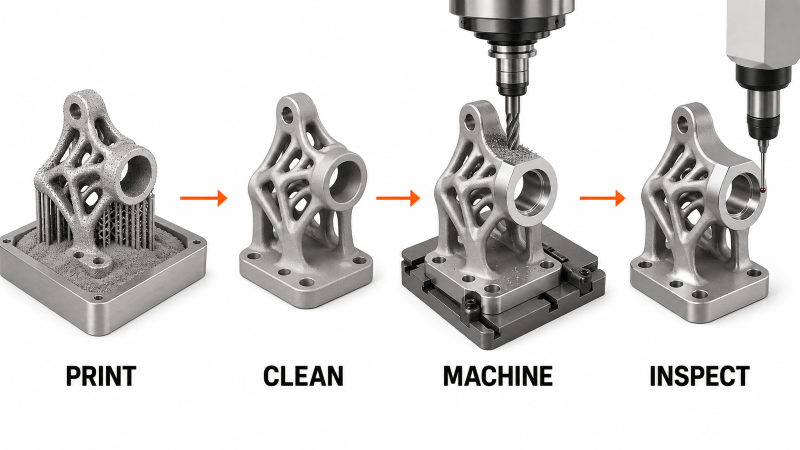
When Should You Combine CNC and Additive Manufacturing?
Additive and subtractive manufacturing are complementary rather than competing technologies.
A hybrid workflow may:
-
Additively manufacture the near-net geometry.
-
Remove supports and perform heat treatment.
-
Establish datum surfaces.
-
CNC-machine bores, threads, sealing faces and interfaces.
-
Inspect critical dimensions.
-
Apply the required surface finish.
This approach preserves complex internal geometry while achieving controlled critical surfaces.
Hybrid manufacturing can also be used to add features to existing components, repair worn areas or manufacture parts that cannot be completed efficiently by either process alone. Oak Ridge National Laboratory describes hybrid manufacturing as a combination of additive and subtractive processes for geometrically complex, dimensionally accurate parts: ORNL hybrid manufacturing research.
Industry Applications
Aerospace
CNC machining is used for precision brackets, housings and structural parts. Additive manufacturing is useful for lightweight structures, integrated channels and consolidated components.
The final process must be qualified according to the material, loading, inspection and traceability requirements. See Samshion’s aerospace manufacturing capabilities.
Robotics and Automation
CNC machining is suitable for actuator housings, shafts, mounting interfaces and precision joints. Additive manufacturing can produce customized end effectors, cable-routing features and lightweight structures.
Explore Samshion’s robotics manufacturing solutions.
Medical and Laboratory Equipment
CNC machining provides controlled interfaces and broad engineering-material availability. Additive manufacturing can support patient-specific geometry, lightweight structures and complex fluid pathways.
Material compliance, cleaning, biocompatibility and process validation must be evaluated separately from basic manufacturability.
Industrial Equipment
CNC machining is commonly used for fixtures, valve bodies, housings and machine components. Additive manufacturing may be selected for replacement parts, complex ducts, repair operations and low-volume specialized components.
Quality Control and Inspection
The inspection plan must match the manufacturing process and the function of the part.
CNC machining quality control may include:
-
Material verification
-
First-article inspection
-
In-process measurement
-
Tool-wear monitoring
-
Dimensional inspection
-
Surface-roughness measurement
-
CMM reporting
Additive manufacturing quality control may additionally include:
-
Feedstock traceability
-
Build-orientation records
-
Process-parameter control
-
Build monitoring
-
Density or porosity evaluation
-
Heat-treatment records
-
Support-removal verification
-
Non-destructive testing
-
Final machining inspection
AM parts should not be accepted solely because their external dimensions are correct. Internal integrity, material condition and post-processing may also be critical.
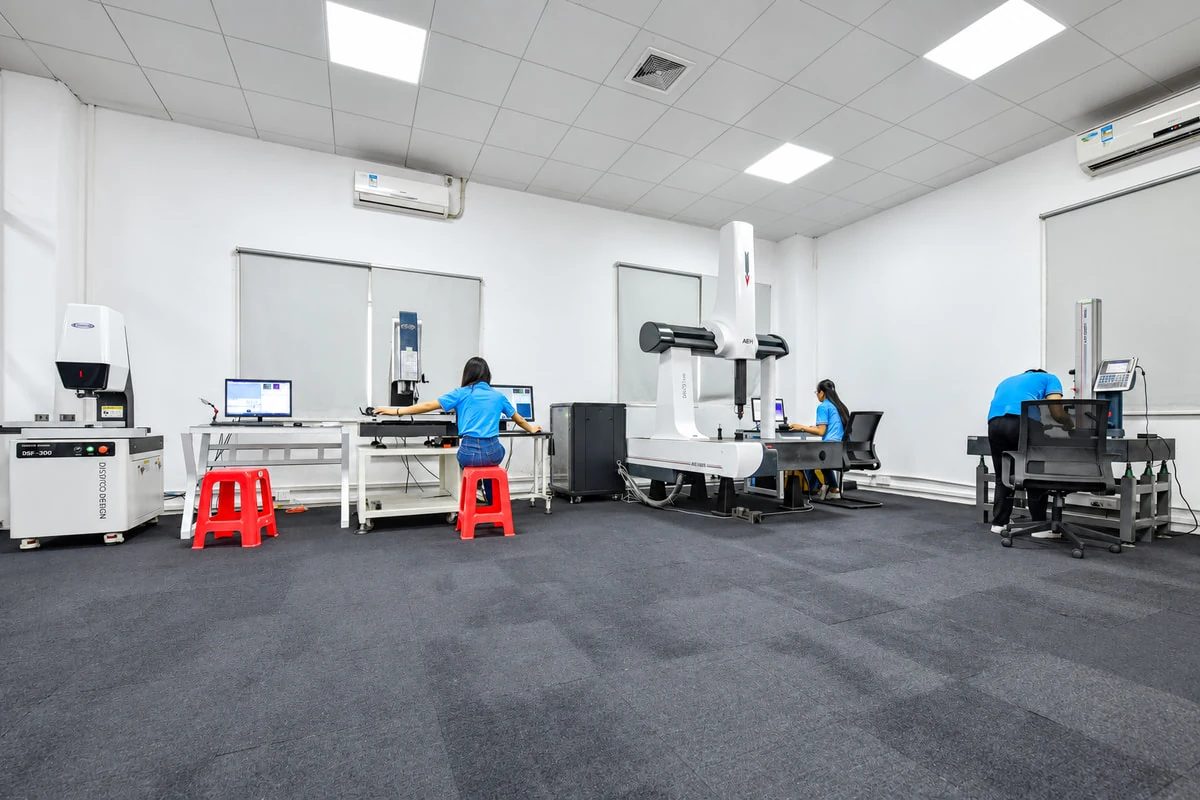
Learn more about Samshion’s quality assurance and inspection systems.
CNC or Additive Manufacturing Decision Checklist
Before selecting a process, answer these questions:
-
What material and material condition are required?
-
Are there enclosed internal channels or lattices?
-
Can cutting tools access every feature?
-
Which dimensions are functionally critical?
-
What surface finish is required?
-
Is material anisotropy acceptable?
-
How many parts are needed now and later?
-
Can supports or powder be removed?
-
Is heat treatment required?
-
Which inspection documents are required?
-
Will critical AM surfaces need CNC finishing?
-
Is the prototype expected to use the same process as production?
A manufacturing engineer should review the complete CAD model, drawing, quantity and application before recommending the final route.
CNC Machining vs Additive Manufacturing FAQs
Is additive manufacturing always faster than CNC machining?
No. Polymer printing may be faster for some concept models, but a simple metal component can sometimes be machined from available stock more quickly than it can be printed, cooled, heat-treated, cleaned and finish-machined.
Is additive manufacturing always cheaper for prototypes?
No. Cost depends on material, geometry, build time, supports, post-processing and inspection. Simple metal prototypes are often economical to machine, while highly complex internal geometry may favor additive manufacturing.
Are CNC-machined parts always stronger?
Not in every case. CNC parts machined from wrought stock generally have well-established material properties. AM properties depend on the selected technology, build orientation, parameters and post-treatment. Qualified AM components can achieve demanding performance requirements, but process-specific data is necessary.
Can additive manufacturing achieve CNC tolerances?
Some AM processes can produce accurate features, but precision bores, sealing faces, threads and mating surfaces frequently require CNC finishing. Tolerance capability must be evaluated for the specific feature and process.
Which process is better for metal prototypes?
CNC machining is often preferred for simple or moderately complex metal parts requiring production material, controlled dimensions and smooth surfaces. Metal AM is preferred when internal geometry, lightweighting or part consolidation provides enough value to justify its post-processing requirements.
Which process is better for production?
Both can support production. CNC machining is efficient for repeatable batches of tool-accessible components. AM is valuable for customization, complex low-volume production and geometries that provide a functional benefit through printing.
Can CNC machining create internal channels?
CNC machining can create open channels, drilled passages and accessible cavities. Completely enclosed, curved internal channels usually require separate parts, special construction methods or additive manufacturing.
Can CNC and additive manufacturing be used on the same part?
Yes. A part can be printed near net shape and then CNC-machined on its critical surfaces. This is a common hybrid strategy for combining geometric freedom with controlled dimensional interfaces.
Choose the Right Manufacturing Process
The choice between CNC machining and additive manufacturing should be based on engineering requirements rather than a general assumption about speed or price.
CNC machining is usually the stronger choice for production-grade stock, controlled dimensions, smooth surfaces and repeatable batches. Additive manufacturing is the stronger choice when internal complexity, customization, lightweight structures or part consolidation creates clear value.
When a project requires both advantages, a hybrid additive and CNC process may provide the best result.
Upload your CAD files to request a process recommendation, DFM review and manufacturing quote.