Acetal is widely used for bushings, guides, rollers, manifolds and precision mechanisms because it offers low friction, good wear behavior and low moisture absorption compared with many other engineering plastics. Delrin is a well-known acetal homopolymer trade name, while POM also includes copolymer grades.
The names are often used interchangeably in RFQs, but grade and stock form still matter. The supplier should know whether the requirement is homopolymer, copolymer, filled, food-contact, static-dissipative or another controlled grade before production starts.
Key Takeaways
- Specify the required POM grade rather than only a colour.
- Keep tools sharp and remove chips before they recut the surface.
- Support bores and thin sections without forcing them round.
- Protect burr-sensitive edges and inspect them under suitable lighting.
- Use functional tolerances where assembly requires them instead of tightening every dimension.
Delrin, Acetal and POM: What the Drawing Should Say
POM is the polymer family. Delrin commonly refers to an acetal homopolymer product line, while acetal copolymers are supplied under other names. They can differ in centre-line porosity tendency, chemical behavior and processing history.
For purchased stock, identify grade, colour, stock form and certification. A generic callout such as ‘black plastic’ is not enough for a repeatable production order.
Machining Behavior and Chip Control
POM often produces continuous chips and can machine to a clean finish with sharp tools. Problems appear when chips wrap around the tool, recut the surface or trap heat. Toolpath, flute space and chip evacuation should therefore be planned together. For additional polymer-specific process guidance, consult the Ensinger machining guidelines for semi-finished plastics, particularly when reviewing heat generation, chip evacuation and stress in semi-finished stock.
Rubbing and dull tools can smear edges. A lighter finishing cut is useful only when the tool remains engaged cleanly and the wall is supported. See our polymer CNC machining challenges.
Workholding Rings, Bushings and Thin Covers
Round parts may become oval if the jaws concentrate pressure. Soft jaws, split sleeves, expanding mandrels or full-contact nests can distribute load. For flat parts, vacuum or sacrificial-tab strategies may help when edge access is important.
Inspect the part after releasing the fixture. A dimension measured only under clamping force does not describe the free component delivered to the customer. See our CNC turning services.
Threads, Press Fits and Bearing Surfaces
POM is often used for sliding or rotating features, so the drawing should distinguish between a nominal clearance and a true bearing fit. Consider operating temperature, mating material, lubrication and load rather than copying a metal fit table. See our CNC fixturing and setup guide.
For threads, provide adequate engagement and avoid sharp roots. Repeated assembly or high torque may justify an insert, but insert installation can introduce local stress.
Tolerance and Inspection Strategy
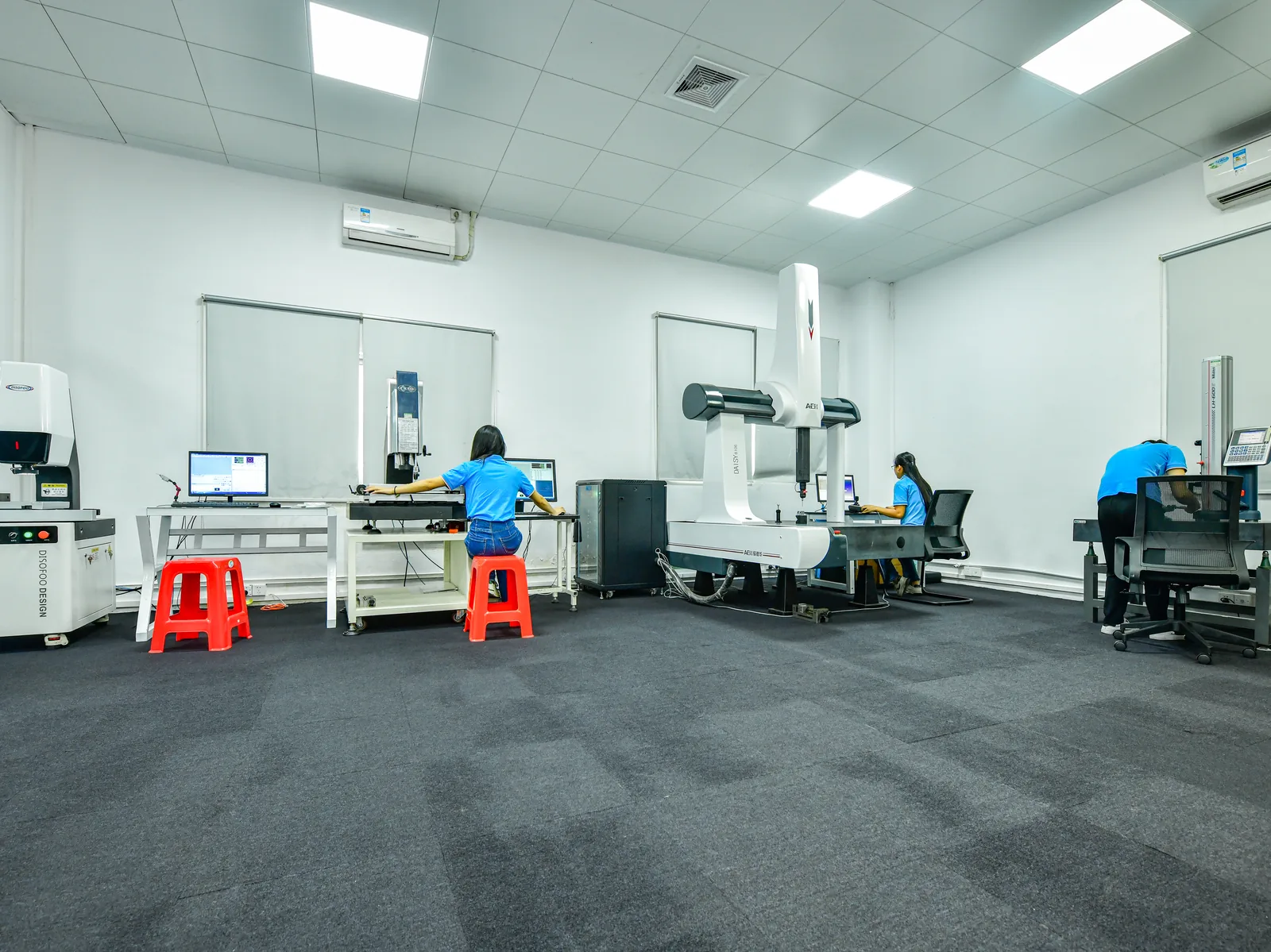
A realistic plan controls the dimensions that govern fit, position and sealing while allowing economic tolerance elsewhere. Measurement force should be low enough that a flexible feature is not compressed by the gauge.
Record inspection temperature when critical fits are sensitive to thermal expansion. Functional gauges are often valuable for mating features and repetitive production.
RFQ Checklist for Machined POM Parts
- Exact resin grade and colour
- 3D model plus controlled 2D dimensions
- Operating temperature and mating components
- Critical bores, fits, threads and surface requirements
- Quantity, cleaning and inspection documentation
Homopolymer vs Copolymer POM
- Homopolymer (POM-H, for example Delrin): slightly higher strength, stiffness and hardness, and a little better wear resistance. It can have a porous centerline in thick rod and plate, which matters for parts that must seal or hold pressure.
- Copolymer (POM-C): very similar to machine, with better resistance to hot water and alkaline chemicals and less centerline porosity. It is the more common stock material for general machined parts.
- Filled grades: glass-filled POM is stiffer but more abrasive on tools; PTFE-filled POM slides with lower friction for bearings and guides.
If the drawing just says “POM” or “Delrin”, tell us whether homopolymer is required, because the two are often interchanged for prototypes.
Cutting Parameters That Work for POM
POM is one of the easiest plastics to machine, but it rewards a few habits:
- Sharp tools: polished, uncoated carbide or tools made for plastics, with large rake angles. Dull tools rub and leave a fuzzy surface.
- High spindle speed, steady feed: a feed that is too low lets the tool rub and heat the material; keep the tool cutting a real chip.
- Chip control: long stringy chips wrap around tools and scratch the surface, so use chip breaking, peck cycles in deep holes and air blast or coolant.
- Gentle clamping: soft jaws and wide contact areas to avoid crushing thin walls and rings out of round.
A Worked Example: POM Guide Blocks and Rollers
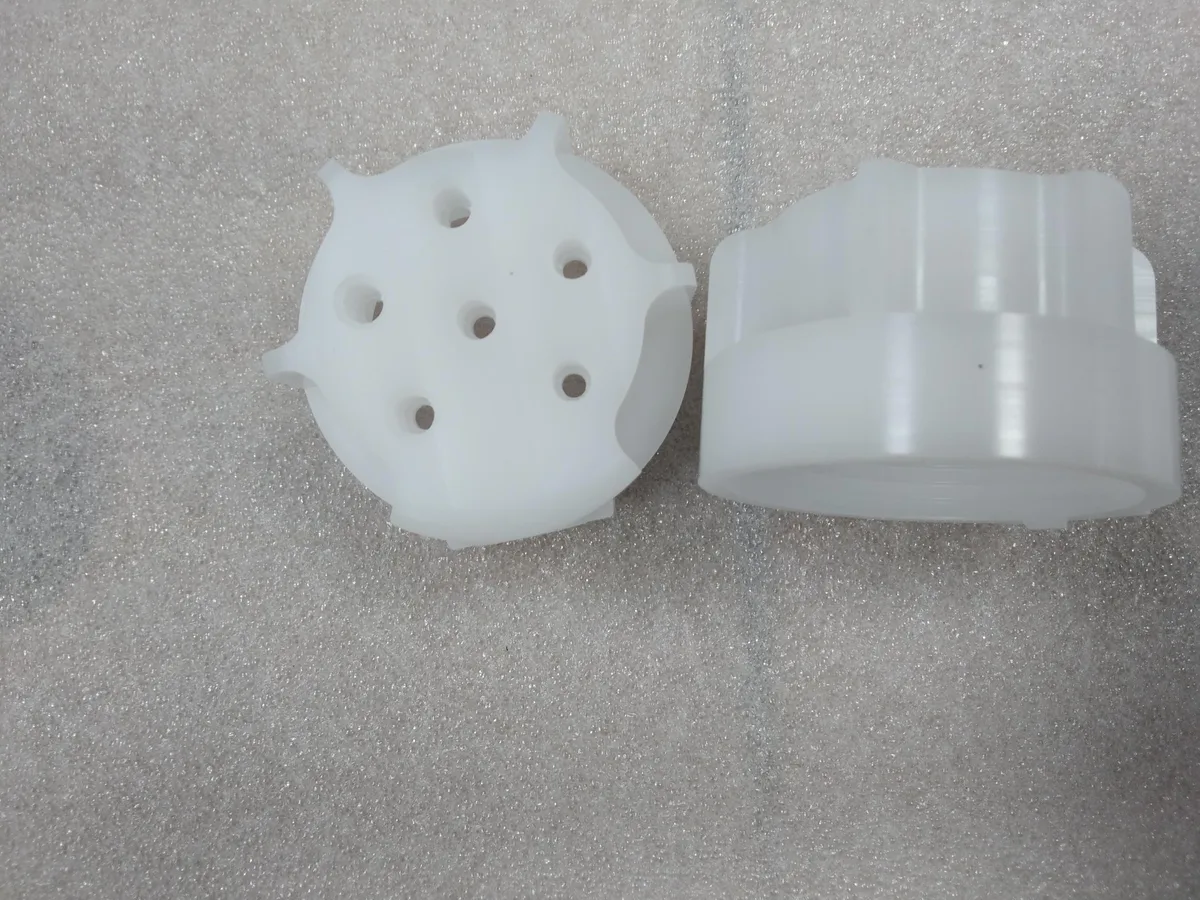
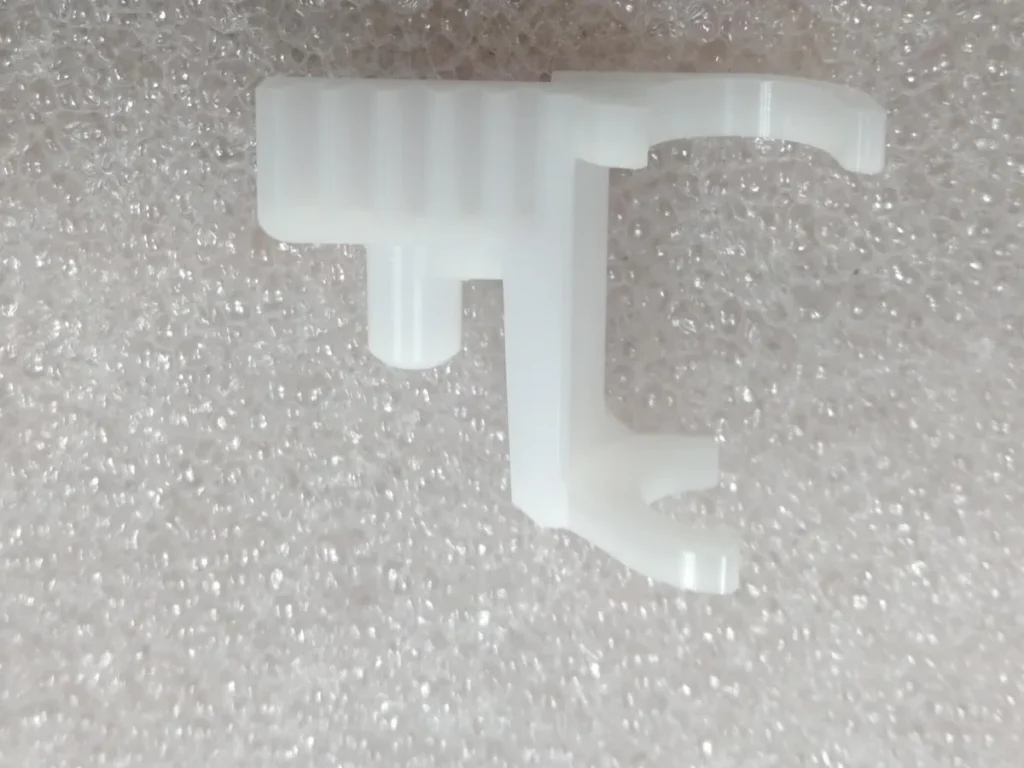
White POM is a common choice for guide blocks, rollers, cams and clips on automation equipment, where it slides against steel without lubrication. For parts like these:
- Bores that run on a shaft are best toleranced for a clearance fit and checked after the part has rested, because POM relaxes slightly after machining.
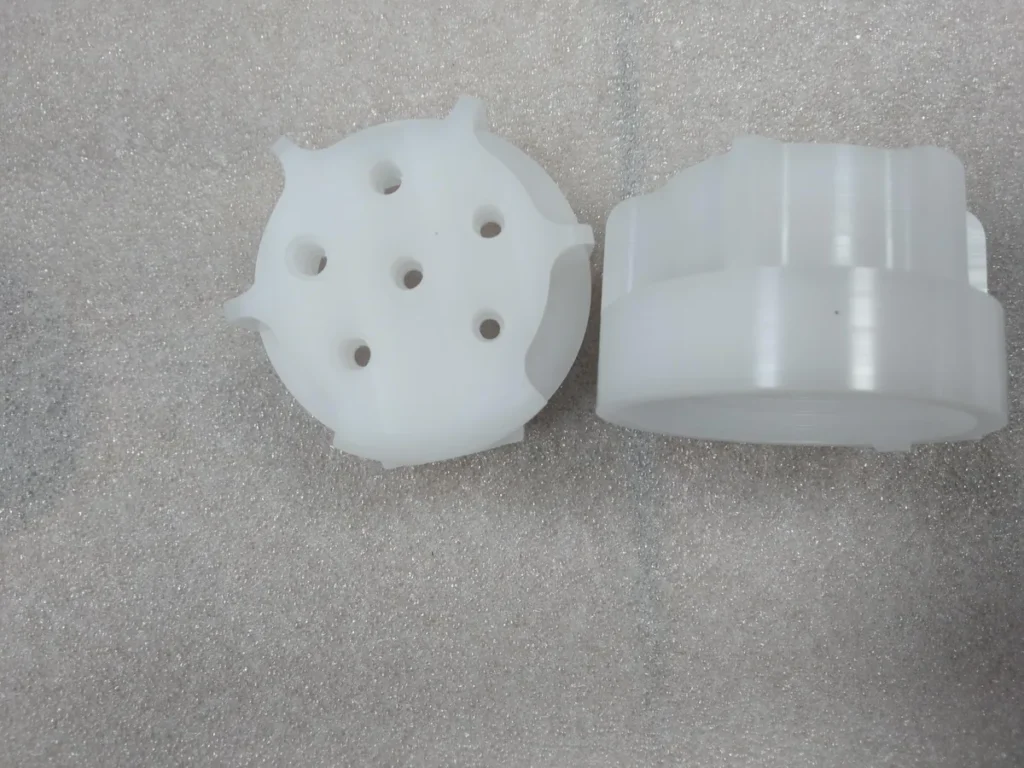
- Through holes and slots are machined in one setup where possible so the hole pattern stays true.
- Sliding surfaces get a fine finishing pass; deburring is done with sharp blades rather than abrasives, which leave fibers on the edge.
For snap-fit clips and latches machined from POM before a part goes to injection molding, see our snap-fit design guide.
Common POM Design Mistakes
- Metal-style tolerances on every dimension. POM expands about ten times more than steel with temperature; ±0.05 mm is a realistic tight tolerance for most features.
- Fine threads in small diameters, which strip easily; use thread inserts for parts that are assembled often.
- Thin walls next to large pockets, which spring after machining.
- Press fits sized like metal, which crack or creep; POM needs less interference.
- Gluing: POM is very hard to bond; design for screws, snaps or press fits instead.
Frequently Asked Questions
Is Delrin the same as POM?
Delrin is a trade name associated with acetal homopolymer. POM also includes copolymer grades, so the exact material should be specified.
Can POM be polished after machining?
Surface improvement is possible, but any secondary method must be checked against size, edge definition and function.
Why does a POM bore become oval?
Jaw pressure, thin wall geometry, residual stress or heat can all contribute.
Does POM absorb water?
POM generally absorbs less moisture than many engineering plastics, but final dimensions still depend on temperature, grade and geometry.
What tolerance can be held on machined POM?
About ±0.05 mm is realistic for most features, tighter on small diameters with care. Untoleranced dimensions follow ISO 2768-mK by default, which we confirm with the customer.
Is POM or PTFE better for a sliding part?
PTFE has lower friction but is soft and creeps under load. POM is stiffer, holds dimensions better and is easier to machine accurately, so it suits most structural sliding parts.
Can POM parts be injection molded later?
Yes. POM is one of the materials we regularly injection mold, so a machined POM prototype can move to molded production once the design is proven.
Get an Engineering Review
Send the exact POM grade, model, drawing and mating requirements for a practical machining and inspection review. When the model and drawing are ready, use request a machining review and include the material, quantity, finish and inspection requirements.
For a review of Delrin CNC machining, send the native CAD model, controlled drawing, material specification, quantity, finishing route and required acceptance records. SAMSHION’s engineering team can return project-specific DFM questions and documented quotation assumptions before production begins.