Plastic bonding is one of the most common yet tricky tasks in DIY repairs, industrial manufacturing, and craft projects. Unlike metal or wood, different plastic materials have unique surface properties, some are porous and easy to bond, while low-surface-energy (LSE) plastics resist most ordinary adhesives. Choosing the right plastic glue model and following standard operating procedures directly determines bond strength, durability, and finished appearance.
Confused about picking plastic glue?
Learn how to match adhesives with ABS, PVC, acrylic, PP, PE & PC, top glue models, critical operation tips and avoid bonding failure for DIY & industrial projects. Below are the six mainstream plastic glue categories with classic, high-performance models, core features, and applicable scenarios.
Cyanoacrylate Adhesive (CA Glue / Super Glue)
CA glue is a popular one-part, fast-curing adhesive for plastic repairs. It cures in the presence of surface moisture and works best on close-fitting, rigid components. It is commonly used for small repairs and the assembly of injection-molded plastic parts.
Top Recommended Models:
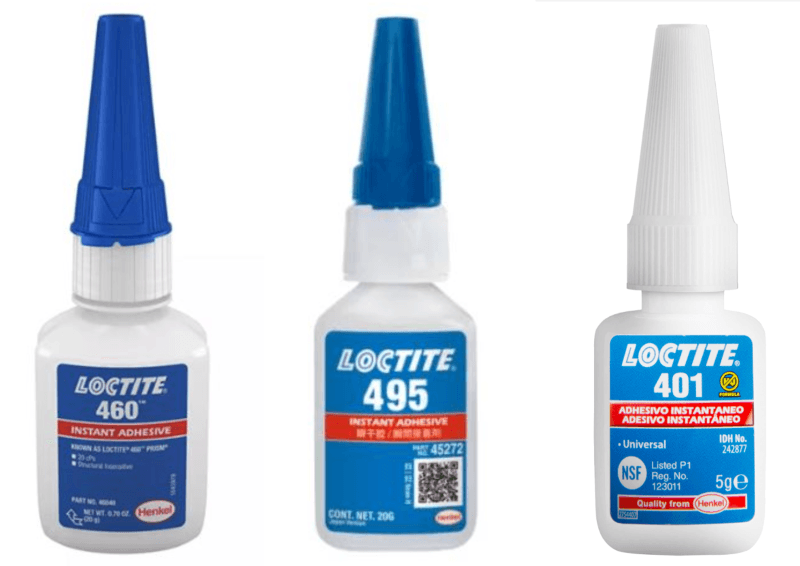
- Loctite 401: General-purpose super glue for ABS, PVC, acrylic, and polystyrene. Low viscosity penetrates tiny cracks, cures in 3–5 seconds for quick daily repairs.
- Loctite 460/495: Toughened modified CA glue with enhanced impact resistance. Perfect for acrylic, rubber-plastic composites, and slightly flexible plastic parts, solving the brittleness issue of ordinary super glue.
- 502 Universal CA Glue: Budget-friendly household option for hard plastic bonding. Suitable for temporary repairs but features poor vibration resistance and easy brittle.
Best For: ABS, PVC, PMMA (acrylic), PS plastic, small crack repairs, rigid plastic assembly
Limitations: Poor gap-filling ability, brittle after full cure, not suitable for high-vibration or frequently bent plastic parts
Epoxy Resin Adhesive (2-Part Glue)
Epoxy glue consists of resin and hardener (1:1 mixing ratio), providing ultra-high bond strength, water resistance, solvent resistance, and weather resistance. It is the best choice for permanent, load-bearing plastic bonding.
Top Recommended Model: Loctite Epoxy Plastic
This professional two-part epoxy formula is customized for plastic materials. It fully cures in 24 hours, forming a waterproof, impact-resistant, and corrosion-resistant bond. It works on hard plastics, fiberglass, and mixed plastic-metal combinations
Best For: Structural bonding, heavy-load plastic parts, outdoor plastic products, long-term permanent repairs
Limitations: Slow curing speed, requires precise manual mixing, not suitable for quick repairs
Solvent Cement
Solvent cement is a specialized plastic adhesive that softens plastic surfaces to realize molecular fusion bonding, delivering seamless, invisible, and ultra-durable joints. It is the preferred option for plastic pipe and precision plastic assembly.
Main Types & Applications:
- PVC Solvent Cement: Exclusive for PVC pipes, PVC panels, and rigid PVC products, forming integrated fusion joints with no gaps
- Acrylic Solvent Cement: For acrylic (PMMA) and polystyrene bonding, ensuring crystal-clear finished surfaces without glue traces
Best For: PVC pipeline engineering, acrylic display racks, PS model assembly
Limitations: Strong volatility, requires strict ventilation; only bonds identical plastic materials
UV-Curing Adhesive
UV glue is a transparent, one-part adhesive that cures instantly under UV light. It features zero yellowing, high light transmittance, and precise local bonding, making it ideal for transparent plastic products.
Recommended Model: ZDS UV Plastic Adhesive
Best For: Transparent acrylic, polycarbonate (PC) plastic, transparent craft products, precision electronic plastic parts
Limitations: Cannot cure in dark areas; invalid for opaque plastic bonding
LSE Plastic Special Adhesive
Polypropylene (PP) and polyethylene (PE) are typical low-surface-energy plastics that cannot be bonded by ordinary glues. Special LSE adhesives are designed to solve bonding difficulties for these materials.
Top Recommended Models:
- 3M Scotch-Weld DP8010: Industrial-grade structural adhesive for LSE plastics, suitable for PP, PE, POM, and medical plastic equipment bonding, with stable strength and strong environmental adaptability
- 3M AC77/AC78: Matched with primers, ideal for HIPS, PBT, and other hard-to-bond plastic substrates, widely used in automotive and electronic plastic parts
Best For: PP, PE, POM plastic parts, industrial low-surface-energy plastic bonding
Hot Melt Adhesive
Hot melt glue is a non-toxic, fast-forming adhesive with excellent gap-filling performance. It is suitable for temporary and medium-strength bonding of most plastics.
Best For: DIY crafts, plastic decoration fixing, temporary assembly, multi-material composite bonding
Limitations: Poor high-temperature resistance, low structural strength, not for load-bearing parts
Plastic & Glue Matching Cheat Sheet
To avoid bonding failure, refer to this quick matching table for common plastics:
| Plastic Material | Recommended Adhesives & Classic Models | Key Notes & Best Use Cases |
| ABS Plastic | Loctite 401, General-Purpose Epoxy Adhesive | Ideal for rigid plastic repairs, small crack bonding, and structural assembly; wide compatibility |
| PVC Plastic (Rigid) | PVC Solvent Cement, Loctite 401 CA Glue | Solvent cement creates seamless molecular fusion for PVC pipes/panels; CA glue for quick small repairs |
| Acrylic (PMMA) | Acrylic Solvent Cement, UV-Curing Adhesive, Loctite 460 Toughened CA Glue | Solvent cement delivers crystal-clear invisible joints for aquariums/displays; UV glue for transparent precision parts |
| Polycarbonate (PC) | UV-Curing Adhesive, Modified CA Glue (Low-Whitening) | UV glue maintains high light transmittance; avoid strong solvent cement to prevent PC stress cracking |
| PP/PE (LSE Plastics) | 3M Scotch-Weld DP8010, 3M AC77 Special LSE Adhesive | Requires surface primer for maximum bond strength; standard CA/epoxy glues will not adhere to these low-surface-energy plastics |
| POM/Acetal Plastic | 3M AC78 Special Adhesive | Light surface sanding + primer required for reliable, long-term bonding |
Material chemistry, fillers and surface energy all influence adhesive performance. Review our manufacturing materials guide when confirming the plastic grade.
Vital Step-by-Step Precautions for Plastic Glue Application
Even with the correct glue model, non-standard operation will lead to weak bonding, bubbling, or debonding. Follow these key steps for perfect bonding results.
Surface Prep Before Bonding (The Most Crucial Step)
Clean thoroughly: Wipe plastic surfaces with alcohol to remove dust, oil, wax, and stains. Residual grease will completely fail the bond.
Polish rough LSE plastics: For PP, PE, and POM plastics, gently sand the surface with fine sandpaper to increase roughness and surface adhesion.
Keep dry: Ensure the plastic surface is completely dry before gluing; excess moisture will cause uneven curing of CA glue and epoxy glue.
For additional information about cleaning, polishing and other plastic preparation methods, read our plastic surface treatment guide.
Proper Adhesive Dispensing Practices
Control glue dosage: A thin, uniform glue layer works best. Excessive glue will cause slow curing, internal bubbling, and reduced strength; too little glue leads to incomplete bonding.
Mix 2-part glue strictly: For epoxy resin adhesives, follow the exact 1:1 ratio. Uneven mixing causes incomplete curing and permanent weak bonds.
Avoid gap overflow: For precision parts, apply glue locally to prevent overflow and polluting the plastic surface.
Adhesive Curing Requirements & Post-Application Tips
Do not move during curing: Fix bonded parts with clamps or tape during the curing period. CA glue needs 1–5 minutes for initial fixation, and epoxy glue requires 24 hours for full curing.
UV glue full exposure: Ensure the bonding area is fully irradiated by UV light; shaded areas cannot cure normally.
Avoid early stress: Do not apply tension, vibration, or impact to bonded parts before full curing to prevent crack formation.
Mandatory Safety Protocols During Plastic Bonding
Ventilate the working area: Solvent cement and partial CA glue release volatile gases; keep ventilation to avoid inhalation discomfort.
Prevent skin contact: Wear gloves during operation. Once glue contacts skin, clean immediately with warm water or alcohol.
Keep away from children and high temperature: Most plastic adhesives are flammable and need sealed storage in cool environments.
ypical Adhesion Failures: Causes and Troubleshooting Methods
Our rapid prototyping services can help validate joint geometry, adhesive access and assembly performance before production tooling
Weak bonding & easy debonding: Wrong glue model or unclean surface → Replace with matched adhesive and re-clean the substrate
Glue layer cracking: Use brittle ordinary CA glue on flexible plastics → Switch to toughened CA glue or epoxy glue
Bubbles in bonding joint: Excessive glue or insufficient extrusion during fitting → Apply thin glue and squeeze out air evenly
UV glue not curing: Opaque plastic or insufficient light irradiation → Replace with opaque adhesive or enhance UV exposure
Final Thoughts
Successful plastic bonding relies on matching the adhesive model to the plastic material and standardized operating processes. For daily quick repairs, Loctite 401/460 CA glue is the most cost-effective choice. For structural and permanent bonding, 2-part epoxy adhesive is ideal. For hard-to-bond LSE plastics like PP and PE, professional 3M special adhesives are essential.
Always prioritize surface cleaning, precise glue application, and sufficient curing time to maximize bond strength and durability. Please bookmark this guide to solve all your plastic bonding problems in DIY and industrial projects!
If you need molded plastic components designed for bonding or assembly, upload your CAD files for a manufacturing quote.
FAQ About Plastic Glue Bonding
Q1: What is the strongest glue for plastic structural bonding?
Two-part epoxy (Loctite Epoxy Plastic) provides the highest tensile and impact strength for general plastics. For hard-to-bond PP/PE LSE plastics, 3M DP8010 MMA structural adhesive delivers maximum permanent bonding strength.
Q2: Can regular super glue bond PP and PE plastic?
No. Standard cyanoacrylate super glue cannot form stable adhesion on low-surface-energy PP/PE plastic surfaces. Specialized LSE structural adhesive with surface primer is required.
Q3: How long do different plastic glues take to fully cure?
- CA Super Glue: 10–30 minutes initial handling strength, 2 hours full curing
- Two-part Epoxy: 30 minutes initial tack, full structural strength after 24 hours
- UV Curing Glue: Instant surface cure under UV lamp, full strength within 1–3 minutes
- Solvent Cement: 5–10 minutes initial fixing, full molecular fusion after 12 hours
Q4: Is solvent cement safe for acrylic plastic aquariums?
Special acrylic solvent cement is the ideal choice for aquarium acrylic panels. It creates invisible, leak-proof molecular fusion joints. Avoid epoxy glue for aquariums as it leaves thick visible glue lines and risks water leakage.