CNC machining cost is determined by much more than the price of the raw material. Two parts made from the same aluminum alloy can receive very different quotations when their dimensions, tolerances, geometry, surface finish, inspection requirements or order quantities are different.
In most projects, the manufacturer must evaluate programming, setup, machine time, tooling, workholding, material removal, inspection and secondary processing before calculating a reliable price.
This guide explains the 12 major factors that affect CNC machining prices and shows how engineers can reduce manufacturing costs without compromising the functional requirements of the part.
Key Takeaways
Machining time is usually one of the most important CNC cost drivers.
Material price and machinability must be considered separately.
Tight tolerances should only be applied to functionally critical features.
Deep cavities, small internal radii and thin walls increase machining difficulty.
Multiple setups and custom fixtures add programming and labor costs.
Larger quantities distribute fixed setup costs across more parts.
Surface finishing, inspection reports and expedited delivery should be included in the quotation requirements.
A complete CAD model and engineering drawing produce a more accurate quote.
How Is CNC Machining Cost Calculated?
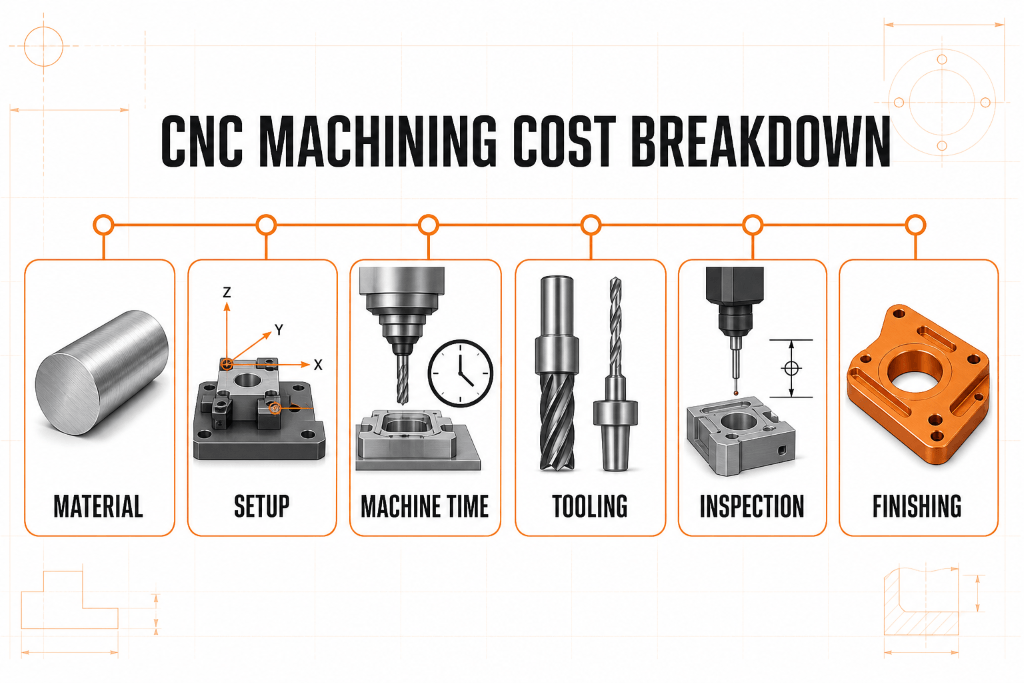
A CNC machining quotation generally includes the following cost categories:
Total batch cost = material + programming and setup + machine time + tooling and fixturing + inspection + finishing + project handling
The approximate unit cost is then calculated by distributing the batch cost across the accepted production quantity.
This does not mean every manufacturer uses the same machine-hour rate or quotation formula. Machine capability, factory location, equipment utilization, labor, tooling strategy and quality requirements all affect the final price.
For this reason, a reliable quotation requires a review of the actual 3D model, drawing, material, quantity and delivery requirements. A simple price-per-kilogram or price-per-hour estimate cannot accurately represent every CNC project.
SAMSHION provides custom CNC machining services for prototypes, low-volume runs and repeat production parts. Each quotation is reviewed according to the specific manufacturing requirements of the component.
1. Material Grade and Machinability
Material selection affects CNC cost in two different ways:
The purchase price of the raw material
The time and tooling required to machine it
A material with a moderate purchase price can still be expensive to machine if it produces high cutting forces, generates excessive heat, hardens during machining or causes rapid tool wear.
Aluminum alloys such as 6061 are generally efficient to machine because they allow relatively high cutting speeds and predictable chip formation. Stainless steels, titanium alloys and nickel-based superalloys normally require more conservative cutting parameters, rigid setups and more frequent tool inspection.
Engineering plastics present different cost challenges. Nylon may absorb moisture, POM requires careful control of heat and clamping, and thin polypropylene components can deform when internal stress is released.
The selected grade also affects availability. A standard plate, bar or tube size is usually easier to source than an uncommon alloy, temper or oversized billet.
Before finalizing the material, compare its mechanical, thermal, corrosion and manufacturing requirements using a manufacturing materials guide.
2. Raw Stock Size and Material Removal
The final part may be small, but the required starting stock can be much larger.
The difference between the initial stock volume and the finished component is sometimes described as the material-removal ratio. A part machined from a large solid billet can require substantial roughing time and produce significant material waste.
This is especially important for:
Deep housings
Large pockets
Thin structural frames
Aerospace-style brackets
Parts with extensive internal material removal
Where production quantity justifies additional preparation, a near-net-shape blank, extrusion, casting or forging may reduce material waste and machining time.
However, these alternatives can introduce tooling costs, minimum quantities and new dimensional considerations. The best option depends on part geometry, annual demand, material performance and required lead time.
3. Total Machining Time
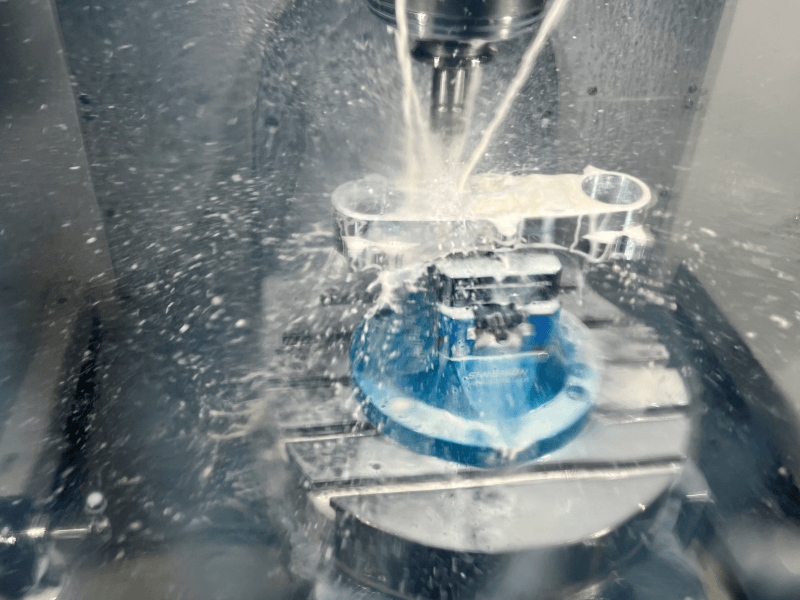
Machine time is one of the most direct contributors to CNC machining cost.
Machining time includes more than the visible cutting operation. It can include:
Roughing and finishing passes
Drilling, tapping and reaming
Tool changes
Probing
Part repositioning
Deburring
In-process inspection
Machine cleaning and preparation
A design that requires longer toolpaths, slower cutting conditions or repeated finishing operations increases the machine time per part.
Removing unnecessary material, simplifying tool access and using machinable materials can reduce cycle time without changing the function of the component.
4. Part Geometry and Tool Accessibility
Complex geometry does not automatically make a part unmachinable, but it often increases programming, tooling and setup requirements.
Cost commonly increases when a part contains:
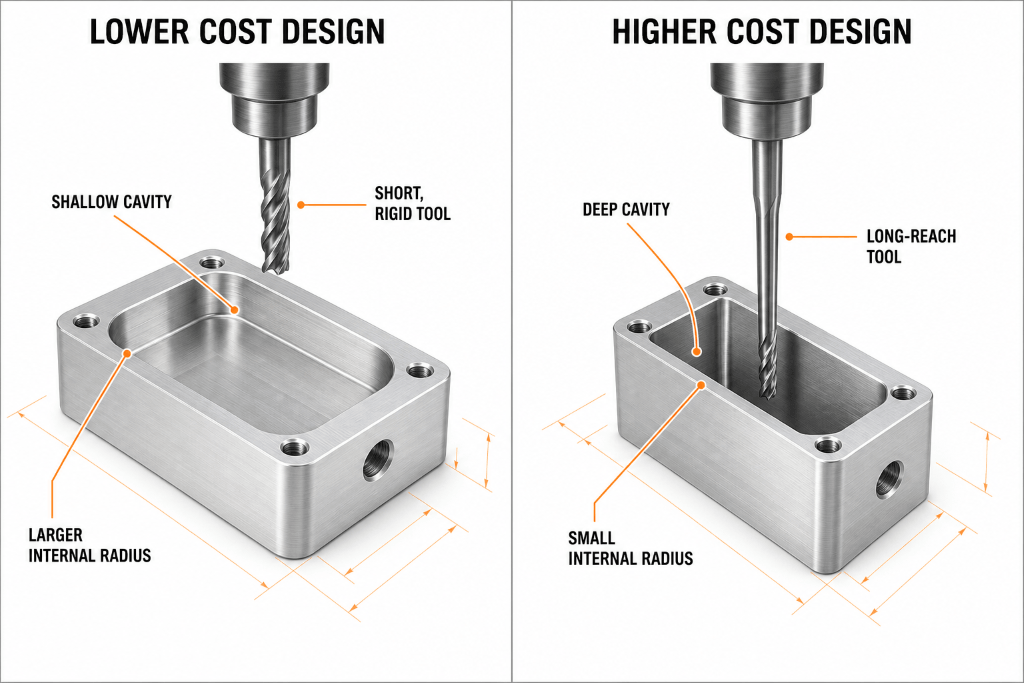
Deep and narrow pockets
Small internal corner radii
Undercuts
Features on many sides
Complex freeform surfaces
Long-reach internal features
Interrupted cuts
Features that cannot be reached with standard tools
A narrow internal corner requires a small-diameter cutting tool. Smaller tools are less rigid, may require slower feed rates and often need more passes to remove the same amount of material.
Whenever the design allows, increase internal radii and provide clear tool access. If several internal corners serve the same function, using consistent radii can also reduce tool changes.
5. Tolerances and GD&T Requirements
Tight tolerances should be applied according to function, assembly and interchangeability, not simply because a CAD system allows more decimal places.
As tolerances become tighter, the manufacturer may need:
More stable machines and fixtures
Additional finishing passes
Lower cutting speeds
Controlled temperature conditions
Intermediate measurements
Higher-accuracy inspection equipment
Additional process development
More frequent tool-offset adjustments
A general tolerance can be suitable for non-critical dimensions, while bearing seats, sealing surfaces, locating holes and assembly datums may require tighter control.
Engineering drawings should clearly distinguish critical features from non-critical geometry. When GD&T is used, datum references and feature controls should reflect the actual functional relationship between components.
Over-tolerancing every dimension increases manufacturing and inspection cost without necessarily improving product performance.
6. Required Surface Roughness
Dimensional tolerance and surface roughness are different requirements.
A component can meet its dimensional tolerance while still showing normal machining marks. If a smoother surface is required, the process may need:
A separate finishing tool
Reduced feed rate
Additional machining passes
Improved toolpath control
Polishing, grinding or lapping
Additional surface inspection
Specify surface roughness only where it affects sealing, friction, fatigue, appearance, coating adhesion or another functional requirement.
Applying the lowest roughness value to every face usually increases cost unnecessarily. Cosmetic surfaces, sealing faces and bearing interfaces should be identified separately on the drawing.
7. Number of Setups and Machined Sides
Every time a part must be repositioned, the manufacturer may need to stop the process, clean the locating surfaces, establish a new work coordinate and verify the relationship between features.
Multiple setups can increase:
Operator time
Fixture requirements
Alignment risk
Programming time
Inspection requirements
Work-in-progress handling
A 5-axis machine may have a higher machine-hour rate than a standard 3-axis machine, but it can sometimes reduce the total cost by machining several faces in one setup.
The most economical method is therefore not always the machine with the lowest hourly rate. The complete manufacturing sequence must be evaluated.
For parts with complex multi-face geometry, review the available CNC milling capabilities before finalizing the design.
8. Deep Holes, Small Features and Threads
Very deep holes, miniature holes and small threads can require specialized tools and careful process control.
Cost may increase because of:
Tool deflection
Chip evacuation difficulty
Tool breakage risk
Reduced cutting speed
Peck-drilling cycles
Additional coolant requirements
Manual inspection limitations
Special taps, thread mills or gauges
Whenever possible, use standard hole and thread sizes. Avoid specifying a fully threaded depth when the additional thread length does not improve the joint.
Blind holes also need sufficient space beyond the functional thread to accommodate the drill point, tap lead and chip clearance.
If a small feature is essential, clearly identify it on the engineering drawing so the manufacturer can evaluate the correct process and inspection method.
9. Workholding and Custom Fixtures
Simple parts can often be held with standard vises, collets, chucks or soft jaws. Irregular, thin or flexible components may require a custom fixture.
Fixture cost is influenced by:
Part shape
Clamping accessibility
Required datum structure
Cutting forces
Risk of deformation
Number of operations
Production quantity
Loading and unloading time
A dedicated production fixture can reduce cycle time and improve repeatability for larger quantities. For a one-off prototype, however, the fixture cost may represent a significant portion of the unit price.
Adding stable locating surfaces or temporary clamping features can make a component easier to manufacture. These temporary features may be removed during a later operation.
10. Order Quantity and Repeat Production
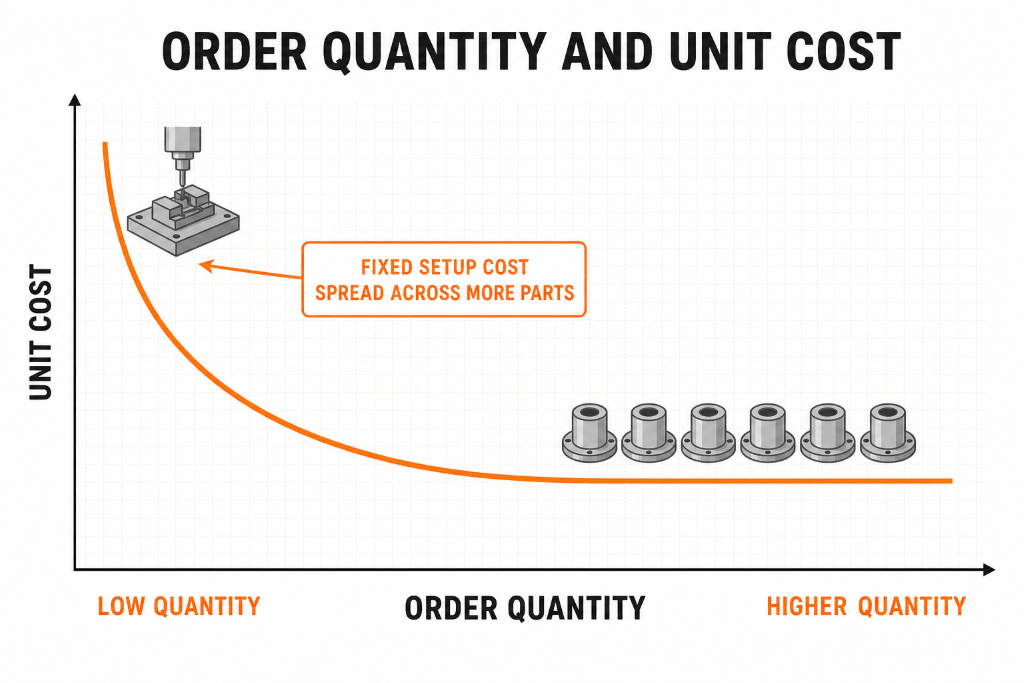
Programming, setup and fixture preparation are fixed costs for a production batch. These costs must still be completed whether the order contains one part or one hundred parts.
As quantity increases, fixed costs are distributed across more components, reducing the setup cost per part.
The cost reduction is not unlimited. Large quantities can require:
Additional raw material purchasing
Tool replacement
Process monitoring
Multiple inspection stages
Dedicated production fixtures
Packaging and inventory planning
Repeat orders may be more efficient when the program, tooling plan, fixture design and inspection method have already been validated.
When requesting a quote, provide both the immediate quantity and the expected annual demand. This helps the manufacturer recommend an appropriate prototype or production strategy.
11. Inspection and Documentation
Standard dimensional inspection is not the same as a full documented inspection package.
Project cost may increase when the customer requires:
CMM dimensional reports
First Article Inspection reports
Full dimensional layouts
Material certificates
Certificates of Conformance
Surface roughness reports
Plating or coating certificates
Serialization and traceability
PPAP documentation
Custom inspection fixtures
Inspection requirements should be agreed before production begins. Critical dimensions, sampling frequency and required reports should be shown on the drawing or purchase documentation.
Learn more about SAMSHION’s quality assurance and inspection systems.
12. Surface Finishing, Lead Time and Delivery
The quoted part price may include more than CNC machining.
Secondary processes can include:
Anodizing
Powder coating
Electroplating
Passivation
Heat treatment
Grinding
Polishing
Laser marking
Assembly
Protective packaging
Finishing cost depends on material, part size, coating specification, masking requirements, color, batch quantity and cosmetic acceptance criteria.
Threads, sealing surfaces, electrical contacts and precision fits may need masking or post-finish machining. Coating thickness must also be considered when finished dimensions are critical.
Review the available surface finishing options before releasing the final drawing.
An accelerated delivery date can also affect material sourcing, machine scheduling, overtime, inspection and external finishing arrangements. Always state the required delivery date when requesting a quotation.
Quick Cost-Impact Summary
| Design or Project Requirement | Typical Cost Impact | Main Reason |
|---|---|---|
| Standard, readily available material | Low | Easier sourcing and predictable machining |
| Exotic or difficult-to-machine alloy | High | Slower cutting and increased tool wear |
| Large material-removal volume | Medium to High | More stock and roughing time |
| Generous internal radii | Low | Larger, more rigid tools can be used |
| Deep narrow cavities | High | Long-reach tooling and slower machining |
| General tolerances | Low | Standard machining and inspection |
| Tight tolerances on selected features | Medium | Additional finishing and inspection |
| Tight tolerances on every feature | High | Extensive process and inspection control |
| One machining setup | Low | Less handling and alignment |
| Multiple repositioning operations | Medium to High | More fixtures, setup time and verification |
| One-off prototype | Higher unit cost | Setup cost allocated to one part |
| Repeat production batch | Lower unit cost | Validated setup distributed across quantity |
| Standard inspection | Low | Routine dimensional verification |
| Full FAI, PPAP or traceability package | Medium to High | Additional documentation and inspection |
| Standard lead time | Low | Flexible production scheduling |
| Expedited delivery | Medium to High | Priority sourcing and scheduling |
How to Reduce CNC Machining Cost
The most effective cost reductions normally come from improving manufacturability before production begins.
Use Practical Tolerances
Apply tight tolerances only to features that control fit, alignment, sealing, motion or interchangeability.
Increase Internal Corner Radii
Larger internal radii allow stronger cutting tools and more efficient material removal.
Avoid Unnecessarily Deep Cavities
Reduce pocket depth where possible or divide the design into manufacturable components when assembly is acceptable.
Use Standard Hole and Thread Sizes
Standard tools reduce special tooling requirements and simplify inspection.
Reduce the Number of Setups
Orient features so that more geometry can be machined from the same direction, or evaluate whether multi-axis machining can consolidate operations.
Provide Stable Clamping Areas
Include accessible locating and clamping surfaces where the part design permits.
Select Materials Based on Function
Do not specify an expensive or difficult-to-machine alloy when a more machinable grade satisfies the mechanical and environmental requirements.
Separate Cosmetic and Functional Surfaces
Identify which faces need premium appearance, low roughness or coating protection instead of applying the same requirement everywhere.
Combine Parts Carefully
Combining several components may reduce assembly, but an excessively complex one-piece design can increase machining time. Compare both manufacturing approaches during DFM.
Request Multiple Quantities
Ask for quotations at several quantity levels, such as 10, 50, 100 and 500 parts, to understand how setup and fixture costs affect unit pricing.
What Information Is Needed for an Accurate CNC Quote?
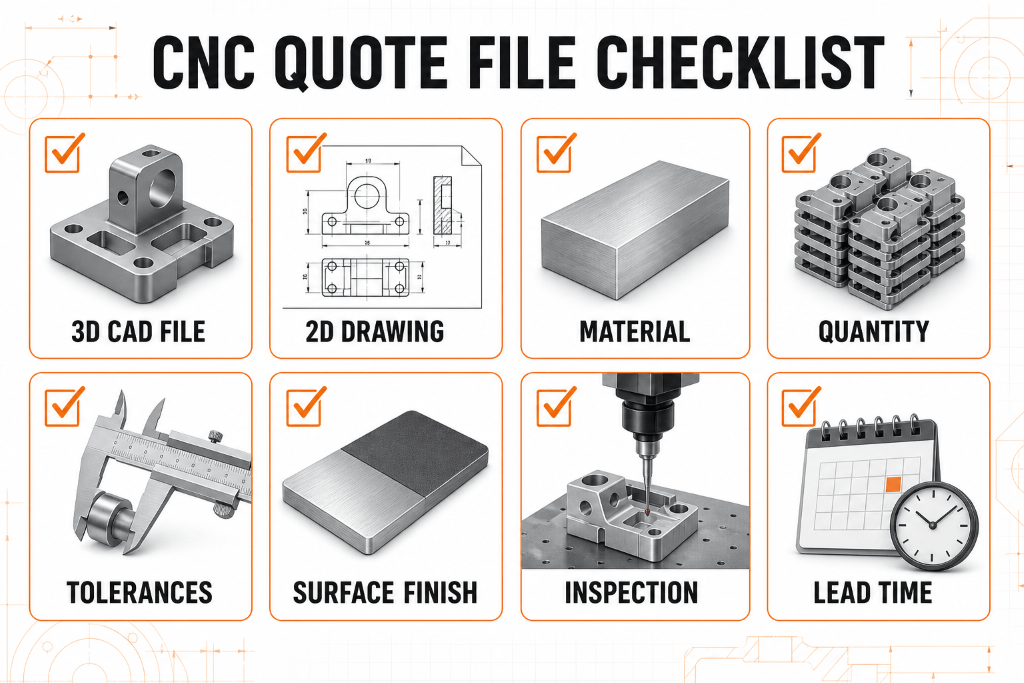
Provide the following information whenever possible:
Native or neutral 3D CAD file, preferably STEP or Parasolid
2D engineering drawing
Material grade and condition
Required quantity
Expected annual quantity
Critical tolerances and GD&T
Thread specifications
Surface roughness requirements
Surface finishing requirements
Cosmetic acceptance criteria
Inspection and documentation requirements
Required delivery date
End-use or functional notes when relevant
A complete manufacturing package reduces assumptions and allows engineers to identify cost-saving opportunities before production.
When Is Another Manufacturing Process More Economical?
CNC machining is highly flexible, but it is not automatically the lowest-cost process for every component.
Consider another process when:
A thin-walled enclosure can be produced through sheet metal fabrication.
A continuous profile can be produced from an extrusion and then finish-machined.
A high-volume metal component can begin as a casting or forging.
A low-load prototype can be produced through additive manufacturing.
A plastic component has sufficient production volume to justify custom injection molding services.
The correct decision should consider tooling investment, part quantity, material performance, dimensional requirements, lead time and future production demand.
Frequently Asked Questions
How much does CNC machining cost?
There is no universal price for CNC machining. The cost depends on material, stock size, geometry, machining time, tolerances, setups, quantity, inspection, finishing and delivery requirements. A CAD and drawing review is required for an accurate quotation.
Why is the unit price higher for prototypes?
Programming, setup, tool preparation and inspection are required before the first acceptable part is produced. In a prototype order, these fixed costs are distributed across only a few components.
Do tighter tolerances always increase CNC machining cost?
Tighter tolerances generally increase cost when they require additional finishing, process control or inspection. The effect depends on the feature, material, geometry and selected manufacturing process.
Is 5-axis machining always more expensive?
A 5-axis machine normally has a higher operating rate, but it may reduce total cost by eliminating setups, simplifying fixtures and improving access to complex geometry. Total process cost is more important than machine-hour rate alone.
Does using less material always reduce cost?
Not necessarily. A smaller or near-net-shape blank may reduce waste, but unusual stock can cost more to source. Material availability, preparation and machining efficiency must be evaluated together.
How can I receive a more accurate quotation?
Submit a complete CAD model, 2D drawing, material, quantity, tolerance, finish, inspection and delivery requirements. Clearly distinguish mandatory requirements from preferred requirements.
Conclusion
CNC machining cost is the result of a complete manufacturing process—not a single material price or machine-hour rate.
Material selection, geometry, tool access, tolerances, setups, quantity, inspection and finishing must be evaluated together. The greatest opportunity to reduce cost usually occurs before production, when the design can still be improved through DFM.
Upload your CAD files, drawing and production requirements to receive a detailed manufacturability review and CNC machining quotation.