Spring making seems simple, but it is a rigorous precision manufacturing technology.
From tiny electronic gadgets and household appliances to heavy industrial machinery and automotive systems, custom and standard springs deliver consistent elastic performance across billions of working cycles.
Little Spring Things Make a Big Difference
Springs are everywhere in our daily life and industrial equipment, but most people know little about their production details. Even small changes in material selection, production steps and post-treatment can greatly affect a spring’s elasticity, service life and stability. Here are some practical springs making tips and basic knowledge to help you better understand how high-quality springs are manufactured.
What’s Spring Manufacturing Processes
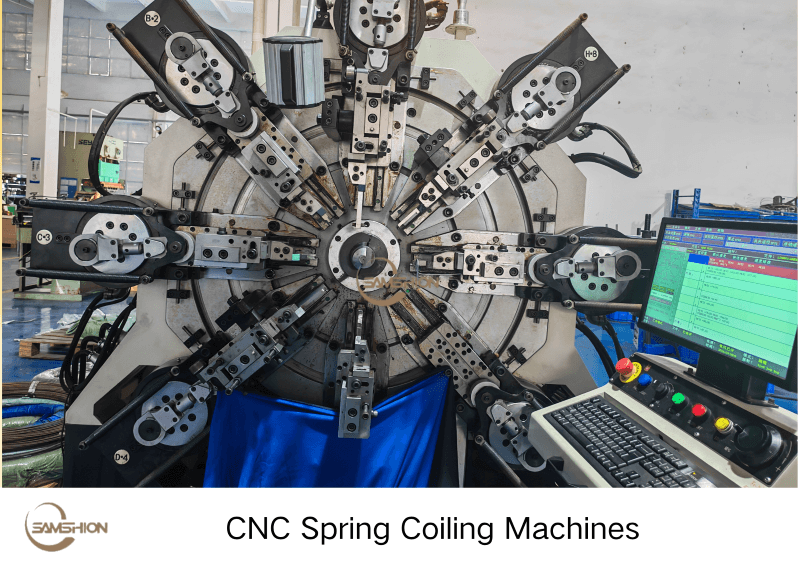
Spring manufacturing is a precision metal forming process, mainly divided into cold forming and hot forming, selected based on wire diameter, material properties, and application requirements. Most commercial springs adopt cold forming for higher precision and efficiency.
Cold Forming Process
Suitable for spring wires with a diameter below 12mm. The process includes wire straightening, precision coiling, end cutting, edge grinding, and stress relief tempering. Cold-formed springs feature stable dimensional accuracy, smooth surface finish, and consistent elasticity, requiring no secondary heating for conventional use. Small springs such as those in keyboards, toys and electronic switches, are all produced through cold forming.
Hot Forming Process
Applied for thick-walled, heavy-load springs with wire diameters over 12mm, such as automotive suspension springs and industrial buffer springs. The raw steel wire is heated to 800–900°C to soften the material, then coiled and formed under high pressure. Hot forming eliminates internal material stress and enhances overall toughness, followed by quenching and tempering to restore elastic strength and fatigue resistance.
Post-Processing
Post-Processing is a vital final step for all springs, including surface treatment (zinc plating, black oxide coating, passivation) for corrosion resistance, load testing, fatigue cycle testing, and dimensional inspection to ensure compliance with design standards.
Why Surface Protection is a Key Finishing Step?
Untreated steel springs easily rust in humid air, and rust will cause uneven stress and eventually spring breakage.
Ordinary springs adopt zinc plating to prevent rust. High-precision springs use passivation treatment for a smooth surface and stable performance. Springs for marine and chemical equipment need advanced anti-corrosion coating to resist acid and alkali erosion.
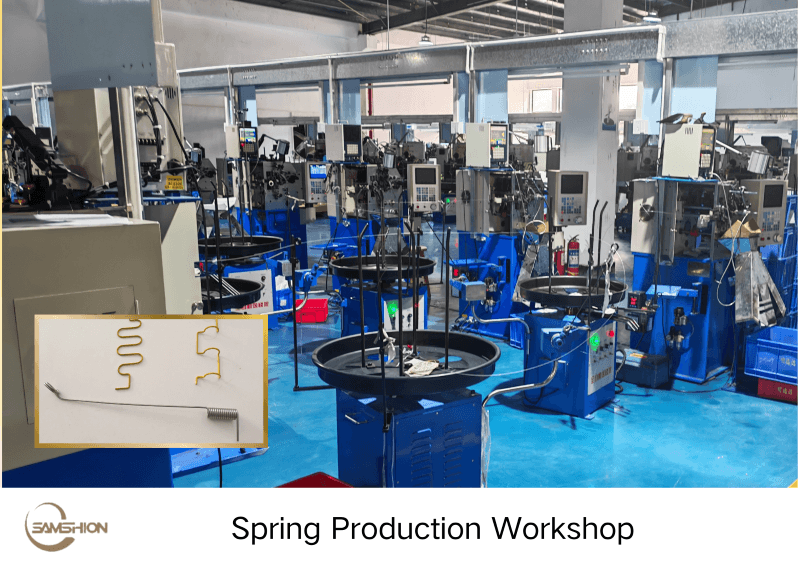
Not All Steel Wires Are Suitable for Making Springs
A common misunderstanding is that any metal wire can be coiled into a spring. In fact, spring raw materials must have strong tensile strength, good toughness and stable fatigue resistance. Ordinary iron wire or low-quality steel will deform easily and lose elasticity after repeated compression and stretching.
How to Choose the Purpose Steel wires for Springs.
Material selection directly determines a spring’s elasticity, fatigue life, temperature resistance, and corrosion resistance. Different working environments require matched spring materials, and the most widely used materials are summarized below.
High-Carbon Spring Steel
The most cost-effective and common material, including music wire (ASTM A228) and oil-tempered steel wire. Music wire boasts ultra-high tensile strength and excellent fatigue resistance, ideal for small precision springs in instruments, switches, and daily hardware. Oil-tempered steel wire features stable performance and is widely used in general industrial springs. The only drawback is poor corrosion resistance, requiring surface anti-rust treatment for humid environments.
Stainless Steel
Mainly 304 and 316 grades, with outstanding corrosion resistance, oxidation resistance, and low-temperature stability. Stainless steel springs work stably in humid, acidic, and alkaline environments, suitable for medical equipment, food machinery, and marine devices. However, their fatigue strength is slightly lower than high-carbon steel, making them unsuitable for extreme high-cycle heavy-load scenarios.
Alloy Spring Steel
Represented by chrome-silicon and chrome-vanadium steel, designed for extreme working conditions. These alloy materials withstand high stress, high temperature, and frequent shock loads, maintaining stable elasticity under long-term high-cycle operation. They are commonly used in automotive suspension systems, engine parts, and heavy industrial equipment.
Copper and Titanium Alloys
Specialized materials for high-end scenarios. Phosphor bronze and beryllium copper have good conductivity, ductility, and corrosion resistance, perfect for electronic contact springs and precision communication devices. Titanium alloy springs feature light weight, high strength, and ultra-strong corrosion resistance, widely applied in aerospace and high-precision medical equipment, though with higher costs.
What is Key Technical Parameters of Springs?
Spring parameters are the core basis for design, production, and model selection, directly deciding load capacity and service performance. The most critical parameters are as follows.
Wire Diameter (d)
The diameter of the spring raw wire, the most basic parameter determining maximum load capacity. A thicker wire means higher rigidity and stronger pressure resistance but weaker flexibility.
Mean Coil Diameter (D)
The average diameter of the spring coil. The ratio of coil diameter to wire diameter is defined as the spring index (C=D/d), a key indicator of spring manufacturability and elasticity. A moderate spring index (4–12) ensures balanced flexibility and structural stability.
Effective Coil Number (n)
The number of coils that can elastically deform during compression and tension. More effective coils lead to softer elasticity, smaller spring rate, and larger deformation range; fewer coils result in harder springs and higher load bearing capacity.
Free Length
The original length of the spring under no load, determining the maximum deformation stroke. It is matched with the installation space during design to avoid ineffective compression or tension.
Spring Rate (k)
Refers to the load required per unit deformation, reflecting spring hardness. It is the core parameter for mechanical matching and directly guides equipment assembly and functional debugging.
Uneven Coils Will Cause Spring Failure
Uniform coil spacing is very important. Handmade or low-precision machine springs often have uneven gaps between coils. During compression, uneven force will lead to local overloading, causing tilt, deformation and even fracture after long-term use.
Why Stress Relief Is a Must for Durable Springs?
After coiling, every spring has internal residual stress. If this stress is not eliminated, the spring will slowly deform, shorten or soften after a period of use, resulting in failure. Therefore, tempering and stress relief treatment is an indispensable step in spring making.
Standard low-temperature tempering can stabilize the internal structure of the metal, improve fatigue resistance, and ensure the spring keeps consistent elasticity after millions of repeated movements. Springs without stress relief have a much shorter service life.
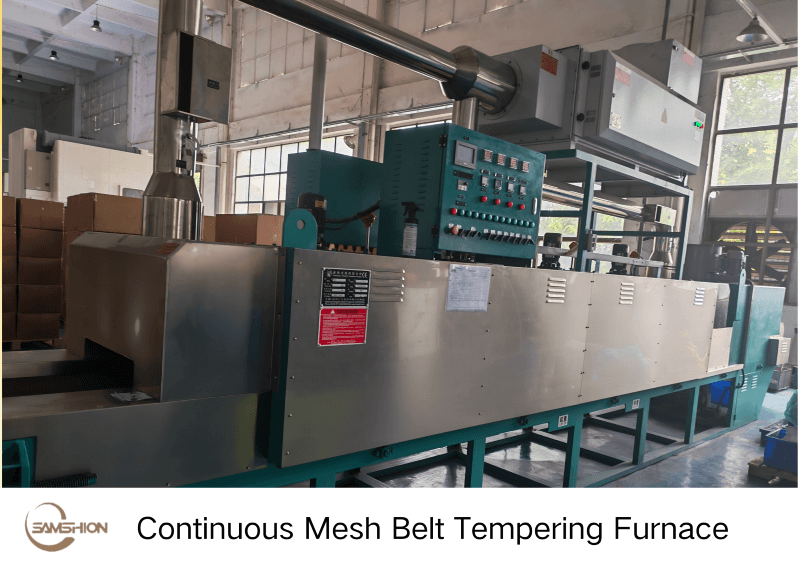
Continuous Mesh Belt Tempering Furnace (Most Common for Standard Springs)
Working Flow:Coiled springs → fall onto mesh belt → slow travel through constant-temperature hot air tunnel (10–60 mins soaking time) → stress removed → cool down at outlet → ready for surface plating.
Batch Box-Type Stress Relief Oven (For Custom/Large Springs)
Sealed Heating Chamber with Hanging Racks/Trays
Workpieces are placed on high-temperature stainless trays or hung on internal rods to avoid overlapping. Perfect for irregular special-shaped springs, alloy heavy-load springs, and stainless steel medical springs.
Internal Hot Air Circulation Blower
Vertical fan inside the oven circulates hot air to ensure uniform heating even for stacked springs.
Independent Temperature Timing Controller
Set fixed heating time; machine auto cuts off heating once timing ends, ideal for small custom orders without continuous production.
What Determines the Hardness and Softness of Springs?
Many users cannot tell why some springs are hard while others are soft. In fact, the tightness of a spring is determined by three simple rules in production. Samshion could adjust these three parameters according to customer load requirements to produce soft elastic springs or hard pressure-resistant springs.
The thicker the steel wire, the harder the spring
First, the wire diameter plays the most direct role. Thicker spring wire delivers greater rigidity, creating harder springs that resist compression or stretching. Thin wire forms soft, lightweight springs with gentle elastic force
The fewer the effective coils, the stronger the support force
The count of effective coils changes spring rate significantly. More active coils mean longer deformation travel and softer elasticity. Fewer effective coils produce stiff springs that barely compress under light loads.
The smaller the spring diameter, the higher the rigidity
With a fixed wire thickness, a larger coil diameter results in a softer spring. Narrow coils generate higher stiffness and firmer rebound force.
Where Different Kinds of Springs Are Used?
According to structural types and functional characteristics, springs are divided into compression springs, tension springs, torsion springs, and special-shaped springs, each with fixed application scenarios.
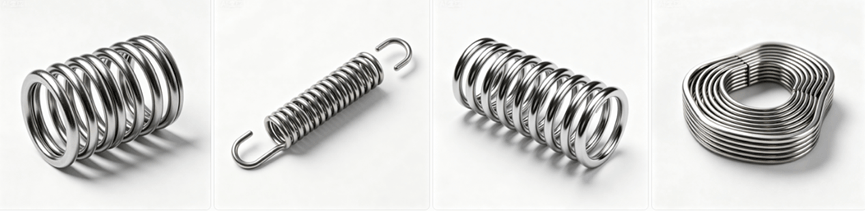
Compression Springs
Most compression springs have flat ground ends for vertical balance, ensuring uniform force distribution during repeated compression cycles. They bear axial pressure to absorb vibration and buffer impact, such as automobile shock-absorbing springs, keyboard switch springs, and mechanical buffer components.
Tension Springs
Designed for tensile load, with hooks at both ends for fixed connection. Common applications include door closer components, exercise equipment, mechanical reset structures, and precision instrument tensioning devices, providing continuous tensile reset force.
Torsion Springs
Torsion springs store and release torsional force instead of tension or compression. They are constructed with tightly wound coils and extended straight arms on both sides. When external torque acts on the arms, the coils twist; once the torque disappears, the springs bounce back to their original position and provide rotational reset power. We can customize the length, bending angle and number of arms to fit rotary mechanical structures. Most torsion springs are made of high-carbon steel or stainless steel, with optional surface plating for rust prevention.
Special-Shaped Springs
Including flat springs, wave springs, and disc springs, customized for limited installation space and special functional needs. They are widely used in precision electronics, aerospace equipment, and high-precision industrial instruments to achieve compact and efficient elastic transmission.
Precision Spring Making: Materials & Machining Tech
Precision spring manufacturing integrates material science and mechanical machining techniques. To produce long-lasting, stable springs, three core factors cannot be overlooked: proper raw material selection, standardized production workflows, and precise parameter configuration.
High-carbon steel, stainless steel and alloy spring steel serve as the primary raw materials for most commercial and industrial spring applications. Custom spring design with calibrated technical parameters ensures ideal compatibility between elastic components and all types of machinery and devices.