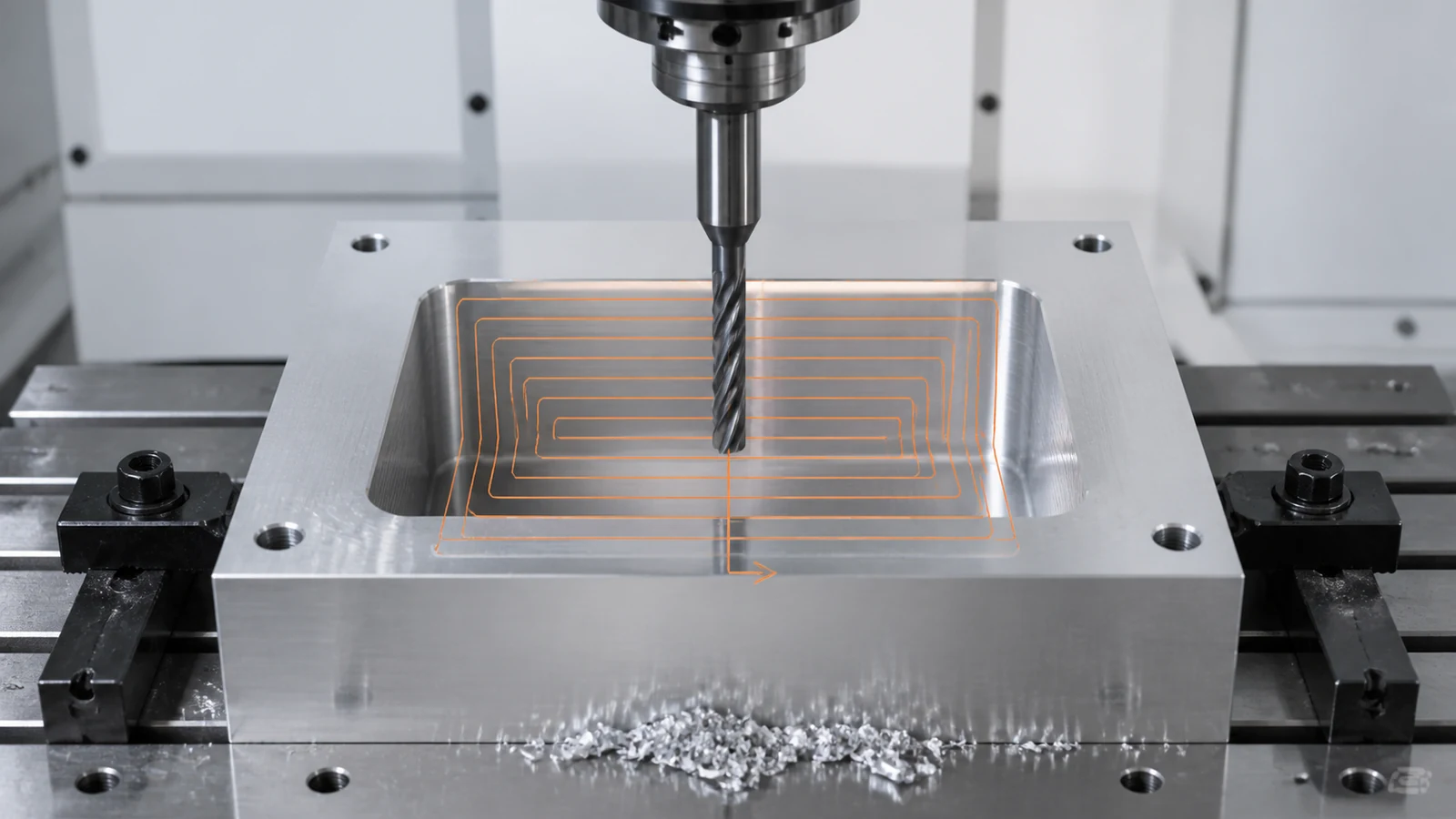
A blind pocket becomes difficult long before its nominal dimensions look unusual. As the cutter reaches deeper, stiffness falls, chip recutting rises and the wall can behave differently at the rim, mid-depth and floor.
A reliable plan therefore treats depth, opening size, corner radius, tool access, roughing sequence, coolant delivery, floor transition and measurement access as one connected problem.
Scope, Search Intent and Technical Boundary
This article addresses deep, enclosed milled cavities where tool reach and chip evacuation dominate. It does not repeat the broader sharp-corner or general CNC milling guides. For an additional authoritative reference, consult Sandvik Coromant pocket-milling application guidance.
Designers, quality teams and sourcing personnel can use this workflow to expose assumptions about CNC machining deep pockets before material is released.
Key Takeaways
- Reduce unnecessary depth before optimizing the toolpath.
- Use the largest internal radius the function permits.
- Separate efficient roughing from a controlled semi-finish and finish strategy.
- Give chips and coolant a credible path out of the cavity.
- Design features so the finished floor and walls can be verified.
Why Depth Changes the Milling System
Cutter overhang, holder clearance, flute capacity and local wall stiffness change as the tool moves below the pocket opening. For the corresponding manufacturing decision and capability context, consult SAMSHION’s custom CNC milling services.
Design the Opening and Internal Radii for Access
A wider opening and larger radius allow a shorter, stiffer tool and a more stable cutting path. For the corresponding manufacturing decision and capability context, consult SAMSHION’s internal corner radius design guide.
Rough the Cavity without Trapping Chips
Entry strategy, step-down, radial engagement, coolant and intermittent clearing must prevent chips from being recut against finished surfaces. For the corresponding manufacturing decision and capability context, consult SAMSHION’s CNC cutting tool selection guide.
Finish Walls and Floors without Dwell Marks
Semi-finishing creates uniform allowance; the finish path should control deflection, corner engagement and the transition into the floor. For the corresponding manufacturing decision and capability context, consult SAMSHION’s CNC surface roughness guide.
Plan Inspection before the Pocket Is Released
Deep walls, small openings and radiused floors can block probes and ordinary depth tools, so the acceptance method belongs in DFM.
Engineering Variables to Confirm Before Quotation
Pocket depth relative to opening and cutter diameter
For CNC machining deep pockets, pocket depth relative to opening and cutter diameter requires an explicit engineering decision. Connect this variable to the mating or sealing function it protects. Ask which function depends on it, which datum or material state establishes it, and at what production stage it will be accepted. It may determine whether a flexible prototype route remains suitable for repeat production. If the customer cannot confirm it, state the working assumption and its commercial effect in writing.
Minimum wall and floor stiffness
For CNC machining deep pockets, minimum wall and floor stiffness requires an explicit engineering decision. Make the functional intent visible before tooling is selected. Ask which function depends on it, which datum or material state establishes it, and at what production stage it will be accepted. A different answer may require different stock, clamping pressure or inspection equipment. The review is complete only when production and inspection use the same definition.
Internal corner radius and bottom fillet
For CNC machining deep pockets, internal corner radius and bottom fillet requires an explicit engineering decision. Connect this variable to the mating or sealing function it protects. Ask which function depends on it, which datum or material state establishes it, and at what production stage it will be accepted. It can alter support strategy, cutter access and the order of finishing operations. Where two documents disagree, obtain a controlled clarification before releasing material.
Holder and spindle clearance above the opening
For CNC machining deep pockets, holder and spindle clearance above the opening requires an explicit engineering decision. Resolve this point while the process route is still flexible. Ask which function depends on it, which datum or material state establishes it, and at what production stage it will be accepted. A different answer may require different stock, clamping pressure or inspection equipment. The review is complete only when production and inspection use the same definition.
Chip volume and coolant access at full depth
For CNC machining deep pockets, chip volume and coolant access at full depth requires an explicit engineering decision. Connect this variable to the mating or sealing function it protects. Ask which function depends on it, which datum or material state establishes it, and at what production stage it will be accepted. It influences whether the feature is produced and accepted before or after secondary finishing. The review is complete only when production and inspection use the same definition. Available grades, stock forms and supplied conditions can be cross-checked against the manufacturing materials guide before quotation.
Probe or gauge access to the finished surfaces
For CNC machining deep pockets, probe or gauge access to the finished surfaces requires an explicit engineering decision. Reconcile the model, drawing and purchase specification at this point. Ask which function depends on it, which datum or material state establishes it, and at what production stage it will be accepted. A clear answer prevents manufacturing convenience from replacing functional intent. Record the agreed interpretation beside the revision so later orders do not reopen the same ambiguity.
Failure Modes and Root-Cause Diagnosis
A long cutter chatters and leaves periodic marks deep in the wall
A characteristic failure for CNC machining deep pockets occurs when a long cutter chatters and leaves periodic marks deep in the wall. The observation is evidence, not yet a root cause. Evaluate material behavior, support, cutter condition, programmed sequence and the measurement alignment as separate hypotheses. Preserve the failed part condition long enough to distinguish cutting evidence from handling or finishing damage. Confirm that the remedy does not transfer error to a mating feature or datum.
Recut chips scratch the floor and overload the tool
A characteristic failure for CNC machining deep pockets occurs when recut chips scratch the floor and overload the tool. The observation is evidence, not yet a root cause. Evaluate material behavior, support, cutter condition, programmed sequence and the measurement alignment as separate hypotheses. Check whether the indication follows the cutter, the setup, the material lot or the inspection alignment. Confirm that the remedy does not transfer error to a mating feature or datum.
Corner engagement pulls a flexible wall out of profile
A characteristic failure for CNC machining deep pockets occurs when corner engagement pulls a flexible wall out of profile. The observation is evidence, not yet a root cause. Evaluate material behavior, support, cutter condition, programmed sequence and the measurement alignment as separate hypotheses. Repeat the measurement with a second suitable method before rewriting the machining program. If the cause remains uncertain, contain the lot and expand the trial before releasing more material.
The pocket meets local size but cannot be inspected to the stated datum system
A characteristic failure for CNC machining deep pockets occurs when the pocket meets local size but cannot be inspected to the stated datum system. The observation is evidence, not yet a root cause. Evaluate material behavior, support, cutter condition, programmed sequence and the measurement alignment as separate hypotheses. Repeat the measurement with a second suitable method before rewriting the machining program. Correct the mechanism and then revalidate the complete functional relationship.
Process Controls for a Repeatable Result
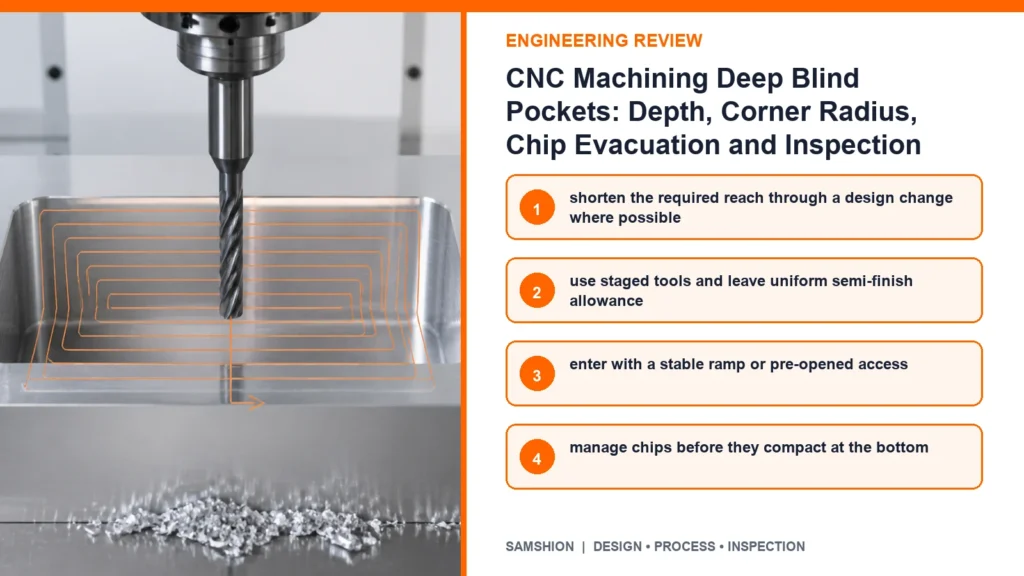
Shorten the required reach through a design change where possible
A process plan for CNC machining deep pockets can control this risk by choosing to shorten the required reach through a design change where possible. The action is useful only when it targets a named source of variation. Before release, consider access, local stiffness, heat flow and the acceptance condition of neighboring features. Define the owner, frequency and record produced by the control. If it changes a controlled requirement, customer approval comes before production release. The applicable production route and process controls are outlined in SAMSHION’s CNC machining services.
Use staged tools and leave uniform semi-finish allowance
A process plan for CNC machining deep pockets can control this risk by choosing to use staged tools and leave uniform semi-finish allowance. The action is useful only when it targets a named source of variation. Before release, consider access, local stiffness, heat flow and the acceptance condition of neighboring features. Verify that the method remains stable after tool change, unclamping or finishing. Retain enough evidence to distinguish setup drift from material or tool variation.
Enter with a stable ramp or pre-opened access
A process plan for CNC machining deep pockets can control this risk by choosing to enter with a stable ramp or pre-opened access. The action is useful only when it targets a named source of variation. Before release, consider access, local stiffness, heat flow and the acceptance condition of neighboring features. Link the method to the part revision, program revision and inspection revision. Escalate a trend before it crosses the acceptance limit.
Manage chips before they compact at the bottom
A process plan for CNC machining deep pockets can control this risk by choosing to manage chips before they compact at the bottom. The action is useful only when it targets a named source of variation. Before release, consider access, local stiffness, heat flow and the acceptance condition of neighboring features. Pair the control with a measurable limit rather than a general workmanship instruction. A stable process is demonstrated by evidence across parts, not by one favorable measurement.
Reduce corner engagement in the final wall pass
A process plan for CNC machining deep pockets can control this risk by choosing to reduce corner engagement in the final wall pass. The action is useful only when it targets a named source of variation. Before release, consider access, local stiffness, heat flow and the acceptance condition of neighboring features. Use a short prototype trial first; formalize fixture, sampling and tool-life rules for repeat orders. Use the simplest method that reliably protects the stated function.
Verify the deepest region before the setup is removed
A process plan for CNC machining deep pockets can control this risk by choosing to verify the deepest region before the setup is removed. The action is useful only when it targets a named source of variation. Before release, consider access, local stiffness, heat flow and the acceptance condition of neighboring features. Verify that the method remains stable after tool change, unclamping or finishing. The inspector must evaluate the same condition the operator is controlling.
Inspection Strategy and Acceptance Evidence
Depth and floor profile from the defined datum
Inspection of CNC machining deep pockets should explicitly address depth and floor profile from the defined datum. First define the characteristic, datum reference and part condition represented by the result. Choose equipment whose uncertainty is small enough to support the stated decision. When results disagree, compare alignment, force, temperature and feature definition before averaging values. The available verification and reporting workflow is summarized in SAMSHION’s quality assurance.
Wall taper at several depths
Inspection of CNC machining deep pockets should explicitly address wall taper at several depths. First define the characteristic, datum reference and part condition represented by the result. Measure in the delivered condition whenever coating, heat treatment or release affects the result. Identify whether each result is measured, visually verified or supported only by material documentation.
Surface damage from chips or tool rubbing
Inspection of CNC machining deep pockets should explicitly address surface damage from chips or tool rubbing. First define the characteristic, datum reference and part condition represented by the result. Correlate shop-floor and final-inspection methods before using either for acceptance. Keep the measurement program and fixture revision with the inspection record.
Position of the cavity relative to external datums
Inspection of CNC machining deep pockets should explicitly address position of the cavity relative to external datums. First define the characteristic, datum reference and part condition represented by the result. Measure in the delivered condition whenever coating, heat treatment or release affects the result. For variable geometry, show the measurement locations instead of reporting one unexplained value.
Cost, Lead Time and Quotation Transparency
Special long-reach tooling and holders
In a quotation for CNC machining deep pockets, special long-reach tooling and holders can influence both lead time and total manufacturing cost. Secondary finishing and final-state inspection can make this more influential than raw cycle time. Offer a DFM alternative only when it preserves assembly, sealing, load or appearance.
Slower metal removal at reduced engagement
In a quotation for CNC machining deep pockets, slower metal removal at reduced engagement can influence both lead time and total manufacturing cost. The quantity and cost of a scrapped blank change how much prevention is economically justified. Compare flexible and dedicated production routes when order volume could justify either.
Additional semi-finish and inspection operations
In a quotation for CNC machining deep pockets, additional semi-finish and inspection operations can influence both lead time and total manufacturing cost. The cost can move from machining into inspection programming, gauging or documentation. Compare flexible and dedicated production routes when order volume could justify either.
Risk associated with a high-value nearly finished blank
In a quotation for CNC machining deep pockets, risk associated with a high-value nearly finished blank can influence both lead time and total manufacturing cost. The quantity and cost of a scrapped blank change how much prevention is economically justified. Tie any cost-saving proposal to a controlled drawing revision.
A Practical Engineering Review Sequence
Start with the function protected by pocket depth relative to opening and cutter diameter. Mark the related datums, interfaces and delivered-state requirements on the controlled drawing. The manufacturing review can then choose stock, setups and cutting access around that function instead of treating every dimension as equally critical.
Walk through the likely failure mechanism represented by this project: a long cutter chatters and leaves periodic marks deep in the wall. Decide which evidence can reveal the problem earliest and which operation can still correct it. This ordering avoids discovering a predictable condition only after finishing or final inspection.
Use the first article to validate the proposed control, including the instruction to shorten the required reach through a design change where possible. The approval part must represent the intended material, fixture, program, secondary operations and measurement alignment. Feed the result back into the process record before releasing the balance of the order.
RFQ and DFM Checklist
- Native 3D CAD model plus a controlled 2D drawing for tolerances and notes
- Exact material grade, condition, stock preference and certification requirement
- Functional datums, mating components and genuinely critical characteristics
- Quantity, prototype or production intent, and expected repeat-order status
- Surface finish, coating, heat treatment, cleaning and marking requirements
- Inspection report, certificate, gauge or sampling requirements
- Any approved alternative geometry or process constraints
Additional Engineering Review Notes
Before approving the quote, run a feature-level review using one realistic manufacturing scenario. For CNC machining deep pockets, examine pocket depth relative to opening and cutter diameter and ask how it could contribute to a condition in which recut chips scratch the floor and overload the tool. One candidate action is to enter with a stable ramp or pre-opened access; however, its value must be demonstrated through surface damage from chips or tool rubbing. Compare the result with a second part, setup or tool-life interval before declaring a systemic cause. Also consider the commercial effect of special long-reach tooling and holders, because a technically sound route must be quoted with transparent assumptions. If the trial confirms the control, apply it to the remaining quantity and monitor the first repeat batch.
Use a short preproduction review to separate necessary controls from inherited drawing habits. For CNC machining deep pockets, examine minimum wall and floor stiffness and ask how it could contribute to a condition in which corner engagement pulls a flexible wall out of profile. One candidate action is to manage chips before they compact at the bottom; however, its value must be demonstrated through position of the cavity relative to external datums. Preserve enough traceability to connect the observation to material lot, setup and program revision. Also consider the commercial effect of slower metal removal at reduced engagement, because a technically sound route must be quoted with transparent assumptions. Remove process steps that add handling but do not reduce the targeted source of variation.
The project team should test whether its acceptance rule still makes sense after all secondary operations. For CNC machining deep pockets, examine internal corner radius and bottom fillet and ask how it could contribute to a condition in which the pocket meets local size but cannot be inspected to the stated datum system. One candidate action is to reduce corner engagement in the final wall pass; however, its value must be demonstrated through depth and floor profile from the defined datum. Retain a marked image or inspection trace so the team is discussing the same location. Also consider the commercial effect of additional semi-finish and inspection operations, because a technically sound route must be quoted with transparent assumptions. The resulting instruction should name the operation, responsible role, limit and retained record.
A practical supplier discussion can begin with one ambiguous or high-consequence feature. For CNC machining deep pockets, examine holder and spindle clearance above the opening and ask how it could contribute to a condition in which a long cutter chatters and leaves periodic marks deep in the wall. One candidate action is to verify the deepest region before the setup is removed; however, its value must be demonstrated through wall taper at several depths. Record the part state and operation where the observation first becomes visible. Also consider the commercial effect of risk associated with a high-value nearly finished blank, because a technically sound route must be quoted with transparent assumptions. Keep the approved method connected to the fixture, program and inspection revision.
Before approving the quote, run a feature-level review using one realistic manufacturing scenario. For CNC machining deep pockets, examine chip volume and coolant access at full depth and ask how it could contribute to a condition in which recut chips scratch the floor and overload the tool. One candidate action is to shorten the required reach through a design change where possible; however, its value must be demonstrated through corner radius and blend into the floor. Record the part state and operation where the observation first becomes visible. Also consider the commercial effect of special long-reach tooling and holders, because a technically sound route must be quoted with transparent assumptions. A control that cannot be checked objectively should be rewritten before it enters the setup sheet.
Frequently Asked Questions
How deep is too deep for CNC pocket milling?
There is no universal ratio; opening, radius, material, tool diameter, holder clearance and acceptance determine feasibility. Supplier and customer should agree the feature definition before production begins.
Why are larger corner radii cheaper?
They permit larger and stiffer cutters and reduce engagement change in corners. Treat this as planning guidance and document any project assumption in the quotation.
Can a small cutter finish the entire pocket?
Sometimes, but unnecessary full-depth use of a small tool can increase time and deflection. Confirm the project-specific answer from the controlled drawing and the actual material condition.
How is a deep pocket floor inspected?
The method may use depth probes, CMM styli, optical access or project-specific gauges. The general rule does not replace a feasibility review of the complete geometry and acceptance method.
Should chips be blown out with air?
The safe and effective method depends on machine enclosure, material, coolant and shop procedure. Treat this as planning guidance and document any project assumption in the quotation.
Get an Engineering Review
Upload the native CAD model, controlled drawing, material specification, quantity and required finish for a project-specific review of CNC machining deep pockets.
For a review of CNC machining deep pockets, send the native CAD model, controlled drawing, material specification, quantity, finishing route and required acceptance records. SAMSHION’s engineering team can return project-specific DFM questions and documented quotation assumptions before production begins. When the model and drawing are ready, use upload your CAD model and drawing and include the material, quantity, finish and inspection requirements.