
Customized CNC Bending Service
Speed up your development cycle with our on-demand metal bending services. Simply upload your 3D models to get started. Our engineering team will quickly analyze your geometric shape, offer free DFM audits along with competitive pricing, and efficiently provide services. From individual prototypes to large-scale OEM production, we can provide precise solutions according to your schedule.
- From Rapid Prototype to Mass Production
- High Precision with Intelligent Angle Compensation
- Accelerated Lead Times via Digitized Manufacturing Workflows
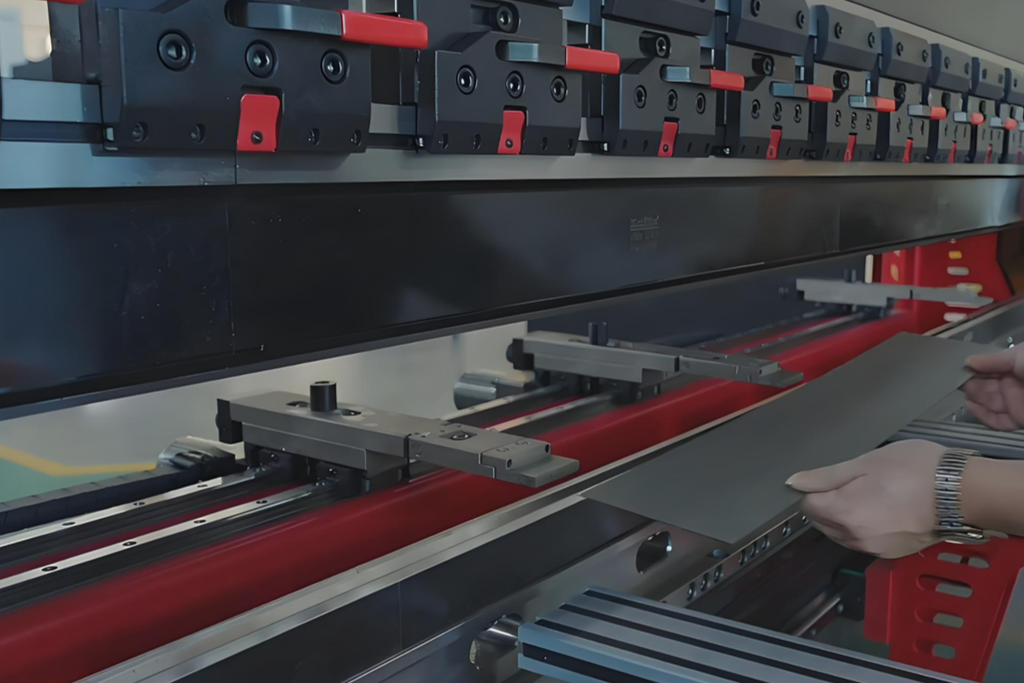
What is CNC Bending?
CNC (Computer Numerical Control) bending is the core process of modern precision sheet metal processing. Through high-precision CNC bending machines, we convert digital drawings into precise geometric shapes. Unlike traditional manual or semi-automatic bending, CNC systems can accurately control pressure, speed, and rear material displacement, ensuring that even the most complex parts can maintain amazing consistency and strict tolerance standards in multiple processes.
At Samshion, it is not only a manifestation of power, but also the art of algorithms. We adopt a multi axis linkage CNC system, combined with real-time angle detection and rebound compensation technology for sheet metal, to automatically correct physical differences between different materials. This means that from the first prototype to mass production on a scale of 10000 pieces, every corner is precise and error free. For high demand industrial applications, this represents lower scrap rates, more perfect assembly coordination, and shorter delivery cycles.
Why Choose Our On-Demand Metal Bending Services?
Cost-Effective with No Tooling Investment
Eliminate expensive mold costs and long lead times with our universal CNC setups. Our agile tooling system adapts instantly to your specific geometry, enabling custom components with zero upfront investment—optimizing your budget from initial concept to final market delivery.
Flexible Customization & Complex Geometries
Handle intricate designs, multiple bends, various materials (aluminum, stainless, steel, copper), and thicknesses – from single prototypes to large-scale OEM production without redesigns.
Free Expert Support & Instant Feedback
Accelerate your development cycle with our dedicated engineering team and automated DFM analysis. We will offer feedback on every file to optimize bend sequences, reduce material waste, and ensure structural integrity—giving you the confidence to move from digital design to physical part within one day.
CNC Sheet Metal Bending Methodologies
This technology represents the core technology used to transform flat metals into complex 3D structures. The following is a professional overview of the main technologies used in our company’s high-precision CNC equipment. Detailed disassembly of each process of CNC bending.
CNC Air Bending
CNC Air Bending is the most versatile forming methodology, where the punch presses the metal sheet into a V-die without forcing it to the bottom. The final angle is digitally controlled by the stroke depth of the CNC press brake rather than the tool’s shape. This process is ideal for rapid prototyping and complex designs featuring multiple distinct angles, as it allows for a wide variety of bends using a single universal toolset.
CNC Bottoming
CNC Bottoming involves stamping materials until it fully contacts the bottom and sides of the V-shaped mold. Samshion’s operators achieve excellent angular consistency and significantly reduce material rebound by forcing the metal to conform to the precise geometric shape of the mold. It is the preferred solution for large-scale OEM production, where the repeated precision and strict tolerances of thousands of parts are crucial.
CNC Coining
CNC Coining is an ultra-precision process that uses extreme pressure to “stamp” the bend into the material, causing actual plastic deformation at the bend line. This immense force effectively eliminates springback, achieving the highest possible precision for industrial components. While it ensures unmatched accuracy, it requires specialized heavy-duty CNC machinery and results in increased wear on the tooling.
CNC Hemming
CNC Hemming is a specialized two-stage fabrication technique where the edge of a metal sheet is folded 180 degrees back onto itself. Integrated into the automated CNC workflow, this process creates a rounded, “dead-fold” edge that enhances structural rigidity and eliminates sharp borders. It is essential for safety-critical parts and high-end enclosures where both user safety and an aesthetic finish are paramount.
CNC Offset Bending (Joggle Bending)
Offset bending is a specialized technique used to create two closely spaced opposite bends in a single stroke, resulting in a small “step” or “Z-shape.” This methodology is essential for creating overlapping joints, where one part of the sheet must sit flush with another, and for stiffening structural panels without adding separate reinforcement brackets.
CNC Rotary Bending (Wiping)
Unlike traditional press brake bending, Rotary Bending uses a rotating “rocker” or “wing” die that folds the metal around a stationary punch. This method is superior for bending extremely short flanges or parts with holes very close to the bend line, as the rotary action supports the material throughout the process, preventing the distortion and “flare-out” often caused by V-dies.
Our bending Technical Capabilities & Specifications
Specification | Capability |
Bending Method | High-Precision Multi-Axis CNC Press Braking |
Standard Tolerances | ±0.1mm (Linear) / ±0.5° (Angular) |
Max Press Force | 50 Tons – 800 Tons |
Max Bending Length | Up to 6,000 mm (236″) |
Thickness Range | 0.5 mm – 20 mm (Material dependent) |
Materials Supported | Aluminum, Stainless Steel, Carbon Steel, Copper, Brass,acrylic |
Backgauge System | 6-Axis High-Speed CNC Synchronization |
Surface Finishes | No-Mar Bending, Brushed, Mirror-Finish Protection and so on |
Production Volume | Rapid Prototyping to High-Volume OEM Runs |
FAQ
What is your standard bending tolerance?
At Samshion, Our standard linear tolerance is ±0.1mm, and the angular tolerance is ±0.5°. For critical prototypes requiring extreme precision, we utilize real-time laser angle measurement systems to ensure zero-defect consistency across every part.
How do you manage material springback?
Our intelligent CNC systems calculate Springback Compensation automatically based on material type and grain direction. For high-precision jobs, we perform physical test bends to calibrate the system before running the full production batch.
How do you handle "Small Flange" bending?
Standard dies require a minimum flange length to span the V-opening. For designs with extra-short flanges, we utilize rotating wing dies or custom offset tooling to achieve precise bends without deforming the edge or the hole nearby.
Do you consider "Grain Direction" during fabrication?
Yes, especially for high-strength alloys and aluminum. We optimize the nesting layout to ensure bends are made perpendicular to the grain direction whenever possible, significantly reducing the risk of cracking and ensuring structural integrity.
What is your approach to "Closed-Loop" or 4-sided box bending with interference?
At prototype stage, when bending the final side of a deep box, the previous bends often interfere with the machine ram. We solve this using segmented gooseneck punches and high-clearance tooling. Our 3D simulation software identifies these “collision zones” during the design phase, allowing us to adjust the bend sequence or tool setup before production begins.